

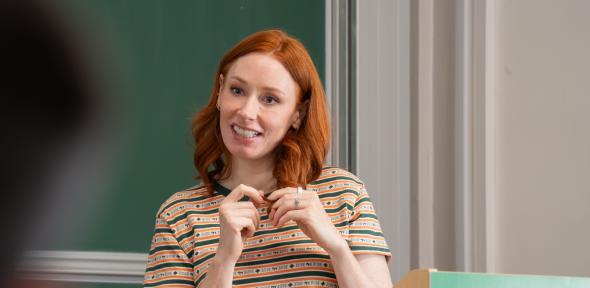
Hundreds of students at the Mathematics Faculty had the unique opportunity to learn directly from an international superstar in mathematics communication: Hannah Fry. As Cambridge's first Professor for the Public Understanding of Mathematics, Fry delivered this year's Rouse Ball Lecture and gave dozens of undergraduates the chance to join follow-on workshops.
"I see two parallel worlds: the tangible world and the underlying mathematical world," said Fry. Her job, she explained, was to find as many bridges as possible between these two worlds.
Fry's Rouse Ball lecture on 'The Unreasonable Effectiveness of a Good Story' in April 2026 not only explored such bridges, but also showed how they can engage people who would normally run a mile from mathematics. Starting with an example from her first ever TED Talk, which covered the mathematics of love, Fry then offered the audience the chance to "choose their own adventure" from the huge range of topics she's covered during her career as a mathematician, broadcaster, and writer. Options ranged from "elephant slang" and "gossip" to "silly AI" and "serial killers".
The choice of "serial killers" touched on Fry's own work as a postdoc at University College London, and also that of the great Sir David Spiegelhalter, Emeritus Professor of Statistics and former Winton Professor for the Public Understanding of Risk. Using serial killer GP Harold Shipman as an example, Fry explained how data on the locations of crimes or deaths can help narrow down the location of a criminal's home. Techniques which harness such data have been used by police in Canada and the UK. And they work in other settings too: from using the locations of malaria cases to find the places where mosquitoes breed to identifying Banksy based on the locations of his art works.
"These are the techniques I really love, where the mathematics is really elegant, but also has a huge impact in the real world," said Fry.
Respect your audience
It was clear from the audience's response that Fry's message landed. "The way that she builds the story, the narrative ....[it brings you] very much inside what she's talking about — it's captivating," said Kris, a postdoc in the Mathematics Faculty.
The captivation is down to Fry's communication skills as much as it's down to the beauty and effectiveness of mathematics. To share those skills, Fry also led two half-day communication workshops for undergraduates, with fellow communicator Matt Parker making a guest appearance.
Over 60 students attended the workshops with palpable enthusiasm. "It's just such a privilege to be able to learn from one of the greats. And we get Matt Parker too!" said Alice, one of the participants.
As Fry explained, the number one principle for good communication is to start with the audience — with what they know and what might interest them. "Everyone has knowledge, it's just a different kind," said Luke, talking about what he learnt at the workshop. "It's about respecting what [your audience] knows because they'll certainly know more than you do in some topic. Your goal is not to force people to learn, your goal is to make people ask questions"
"I think there's almost an aesthetic element to it, finding a way of explaining [the maths that] also appeals to someone's particular aesthetic sense, as well as just tying it to a cool application," said Tada. "A while back things like Fermat's last theorem really did break into the public consciousness. But now pure mathematics, as opposed to applied maths, is disappearing from the public lexicon. It would be nice to reverse that — [to appreciate] maths for its own sake."
Excellence in maths communication
Students who took part in the workshops said they'd like to see communications training become a staple feature of their education as mathematicians. Indeed, public engagement and outreach are a core mission of the Mathematics Faculty. "Mathematics underpins so many aspects of modern life. Communicating [it] to a wider audience has never been more important," said Nick Dorey, Head of the Department of Applied Mathematics and Theoretical Physics.
Fry's work, both in communicating mathematics and in conducting research into how to best communicate it, complements that of other great communicators at the Faculty. These include David Spiegelhalter and Professors Julia Gog, Holly Krieger, David Tong, and Frank Verstraete, as well as members of the Faculty's award-winning education and outreach project, the MMP.
As Fry put it in her invitation to students, communication isn't a soft skill. "[It's] about learning to wield your mathematics in public without losing a single drop of the rigour, wonder, or weirdness that makes it worth caring about in the first place."
Photography by Grace Merton, Isaac Newton Institute