

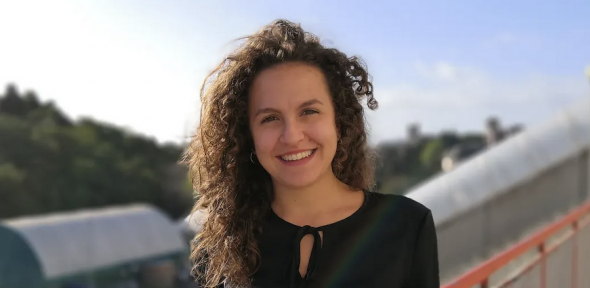
Lisa Valentini is a second year PhD student at the Department of Pure Mathematics and Mathematical Statistics (DPMMS). She tells us about the pleasure of connecting ideas, eureka moments, and what it's like being a Gates Scholar.
My research is in kinetic theory, which explores the behaviour of systems made up of a large number of particles, such as gases or plasmas. These systems can be described at three levels. At the microscopic level we track individual particles using laws of physics that don't involve chance (deterministic laws). At the mesoscopic level we no longer track individual particles, but describe the probability distribution of particles being in particular positions and having particular velocities. At the macroscopic level we treat particles collectively through quantities such as pressure and density, which emerge from their bulk behaviour.
Fluid dynamics focuses on the macroscopic level, whereas kinetic theory studies the microscopic and mesoscopic levels and explores the connections between the three levels. My research actually sits on the intersection of kinetic theory, the theory of partial differential equations (which describe many physical systems), and spectral theory, which helps break down complex mathematical operations into simpler building blocks.
(For those with a technical background my current work focuses on the Kolmogorov–Fokker–Planck equation on bounded domains, a mesoscopic model that describes the joint distribution of particle position and velocity under stochastic effects within a confined region.)
Mathematics suits the way my mind works: I enjoy connecting ideas, much like trails connect places on a map. During my studies at the University of Genova, I developed a strong interest in functional analysis, which treats collections of mathematical functions as if they were geometric spaces, and harmonic analysis, which is again about breaking functions down into simpler components. The two beautifully combine techniques from analysis with techniques from topology, the study of shapes.
During a visiting stay at the Applied Harmonic Analysis Cluster at the University of Vienna, I worked on time-frequency analysis, which focuses on representations of signals in frequency and time (exactly as the musical staff describes a melody with the notes and their duration), and I addressed some spectral problems for the first time. Over time, I felt increasingly drawn toward problems motivated by concrete applications while still allowing for deep abstract thinking. This eventually led me to DPMMS under the supervision of Clément Mouhot. Kinetic theory uses tools from PDE analysis, harmonic analysis, and functional analysis to address physics-motivated questions, making it a perfect fit for my interests.
Working at the Department of Pure Mathematics and Mathematical Statistics is both humbling and inspiring. The intellectual environment is shaped by a continuous exchange of ideas through seminars, lectures, and informal discussions, further enriched by the proximity to the Isaac Newton Institute for Mathematical Sciences next door. Researchers at DPMMS regularly engage with problems at the frontier of mathematical knowledge, where much of the challenge lies in formulating the right questions as much as solving them. Being surrounded by experts at the very top of their fields can feel demanding at times, and it requires persistence and self-motivation. Often, you may not fully understand the conversations happening around you, but that is part of the process. My own experience has taught me that persistence pays off: keep showing up, keep working, and meaningful progress eventually follows.
The kinetic theory community is quite spread across the UK, France, and beyond. This means that much of my daily work in Cambridge is fairly solitary. I usually spend several hours in my office working through proofs or reading recent papers, often accompanied by my collection of small plants. I balance this with attending seminars, meeting colleagues and friends for lunch, supervising undergraduates, and contributing to college life. Outside the CMS, you might find me working in Clare Hall’s allotment, running dance workshops, or crafting my next macramé project: nature, movement, and creativity are my essential ingredients for a good day.
Progress in mathematics is rarely linear. Often nothing works, until suddenly something clicks, and that moment of clarity is one of the most rewarding aspects of research. A professor of logic once told us that every mathematician remembers the first time they experienced that feeling, and I certainly remember mine. About ten days before my Bachelor’s viva, I was revisiting a particular proof to check what would happen if one of its assumptions was removed, and something unexpectedly clicked. What was originally intended as an expository dissertation eventually evolved into my first published article. I still remember that it was a sunny Sunday in July in Italy, and I spent the rest of the afternoon sunbathing on my balcony, letting the moment sink in.
Another equally meaningful mathematical experience comes from teaching. Seeing students gain confidence in their eyes as they begin to understand unfamiliar concepts is deeply rewarding. Mathematics is a subject closely tied to confidence, since progress often depends on believing that understanding is possible. This motivates my engagement in mathematical outreach, where I enjoy translating complex ideas into accessible language. The dissemination activities I have organised in collaboration with the University of Genova and public institutions are among my most memorable mathematical experiences. I find it particularly fulfilling to demystify mathematical language and show that its logical structure is, at its core, profoundly human.
Being a Gates Cambridge Scholar is a constant reminder that academic work does not exist in isolation. It carries a broader responsibility to contribute to society. The Gates Cambridge community is an extraordinary group of people who not only excel academically but are also deeply committed to social leadership and public engagement. I am continually inspired by their stories of fieldwork and initiatives with meaningful social impact. It is motivating to be surrounded by scholars who are driven by purpose, and it is remarkable to see how small ideas, combined with persistence, can grow into projects with lasting impact.
I have already become involved in some scholar-led initiatives, including the Palestine Educational Opportunity Initiative, a mentoring programme that supports Palestinian students applying to universities and scholarships abroad. Through these experiences, I continue to learn from the skills, perspectives, and dedication of the people around me, and they constantly show how much we can grow by working together.