

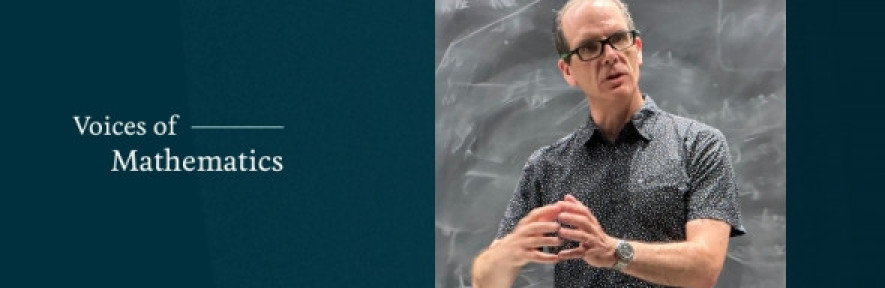
You can listen and subscribe to our Voices of Mathematics podcast through Apple Podcasts, YouTube, Spotify and through most other podcast providers via Podbean - this episode is listed without the transcript on the Maths Faculty website.
The transcript was created using AI to generate the text from the podcast recording, and was then sense-checked and edited for readability and accuracy.
[Musical interlude]
[00:13] Colm-cille Caulfield: That there is such a positive feedback between our research and our teaching for sharing knowledge, generating new knowledge, and also training the next generation who will be able to share and add yet more new knowledge to mathematics.
[Musical interlude]
[00:45] Marianne Freiberger: Welcome to Voices of Mathematics, the podcast from the Mathematics Faculty at the University of Cambridge. I'm Marianne Freiberger.
Julia Hawkins: And I'm Julia Hawkins, and we're both from the Communications Outreach and Engagement team here at the Maths Faculty. So the person you just heard was Colm-cille Caulfield, the outgoing head of the Department of Applied Mathematics and Theoretical Physics, which is known as DAMPT. And Colm was talking about the twin aims of the Maths Faculty: to deliver world-class teaching and world-class research. So Marianne, the reason you went to talk to Colm over the summer is because he's now handing over to a new Head of Department, Nick Dorey. But with 5 1/2 years of experience as Head of Department, we wanted to find out from Colm what it's like being in that role and also what makes DAMTP one of the leading maths departments in the world. And we also wanted to know what it was like leading DAMTP through an unprecedented international crisis with the COVID-19 pandemic, which struck just a few months after he took up that role.
Marianne Freiberger: Yeah, that's right. And I think we both remember Colm's emails from the time, keeping everyone up to date and offering support to people to work from home and things like that. But as Colm told me, the Faculty's COVID response, it wasn't just about that, it was also quite ingenious and it made optimal use of a house full of mathematicians. I visited Colm in his office here at the Centre for Mathematical Sciences earlier in the summer to talk about that and also to learn more about DAMTP's exciting developments and growth since. And I started out by asking Colm what the role of a Head of Department entails.
[Musical interlude]
[02:48] Colm-cille Caulfield: Well, the Head of Department of such a department as DAMPT has many different roles. I think the word that immediately occurs to me is responsibility. The Head of Department is responsible for ensuring the good running of the department, that it succeeds in its joint missions of doing research of the highest international quality and also providing teaching of the highest international quality to our students. And so that involves leadership of academic colleagues, also the professional support staff that provide the support for these two key objectives of research and teaching. And also, it has a role, so I've said it, the responsibility, we have to make sure that the finances are in order, that the working environment is safe, that the provision of all the various teaching and research activity and examinations is done properly. But also, so there's responsibility, there is the leadership of being the person who decides or who makes decisions about how to allocate resources to these various activities. And there's also, I think, a strategic piece of looking at the… towards the future about how to improve the provision of research and teaching given by the department.
So that strategic looking to the future part means that you have to engage with all your colleagues in the department, the academic staff, choosing to recruit them, but also decide how to run the professional support administration associated with these key activities. And then there is another role to be a little bit of the figurehead for the department: to do interviews like this, to engage with stakeholders, with alumni, with possible industrial collaborators, with possible donors, just to gain the resources that ensure that the department can continue to flourish and thrive.
Marianne Freiberger: So that's a lot of responsibilities.
Colm-cille Caulfield: It's a lot of responsibilities.
Marianne Freiberger: A lot of things to do. But to make your life just that little bit harder, not long after you started as Head of Department, the pandemic struck and you guided the department safely through that. Can you give us a sense of what that was like?
[05:26] Colm-cille Caulfield: Well, I think for everybody, the COVID pandemic was a very strange time. I, as you said, I actually became Head of Department in January, and of course the lockdown happened in March, but there were several, several aspects at the very beginning that are really quite interesting.
We're very fortunate in this department to have Professor Julia Gog, who really is a world authority on the mathematical modelling of infectious diseases, and she was very much involved with the British government's response, the committee SAGE and SPI-M, the modelling subgroup. And so I, as this strange disease was being heard of from China, I talked to her and had some correspondence with her about what was happening. So even from February time, we were really concerned. Of course, we didn't know how bad it was going to get, but we were very concerned about it.
And the particular timing, right at the very beginning, it actually coincided right with the end of term. And so, actually, I was very keen to get people to be able to work at home. And so the weekend before the university told us to go to work at home, I asked all the staff to see, to get their computers and such like, to be able to work at home because we really saw how bad the crisis... we had an idea that the work at home pattern was going to be inevitable.
And then I have a very clear memory too of walking around the site after it had been closed down – at the Centre for Mathematical Sciences where mathematics, the two maths departments are based. And I have a skeleton key and going around to these deserted offices, closing windows and so on, as the place was being closed down. So that's my memory of the very beginning.
But then, this was, as I say, March time. So there was still some Easter term teaching that had to be done. And we really had to improvise that, you know, we didn't necessarily have iPads and other digital tools. One person improvised a whiteboard and videoed with their phone. And we just tried to then keep the show on the road. I mean, I have the overwhelming memory of people across the piece really mucking together and working together to just get stuff, the essential stuff done, which really was to maintain our teaching in some way, to engage with the students, and also, crucially, to continue examinations, which was the really vital part, really seeing how we could continue to have credible, reliable examinations for the students so that they could get degrees.
And so then over the period, I just, I was fortunate to have a nice house with a decent garden. But I just remember these very, very long days of these newfangled meetings on Zoom and Teams, just discussing various... trying to work out a way with colleagues how to do it, how to continue to provide our teaching and research. And there was a really wonderful aspect of a kind of triumvirate. There were many people who worked with it, particularly the aspect of very close cooperation with the Head of the Department of Pure Maths and Mathematical Statistics and the Chair of the Faculty Board, because for things like examinations and so on, those were really key components about how we did things. And we would regularly have these conversations to make things happen. This was James Norris was the head of DPMMS at the time, and Andrew Thompson, a professor in the Pure Maths in DPMMS also, was the Chair of the Faculty Board. And we would have these discussions and then with other colleagues, just see how we could make things work. And it was really, really stressful, but it was also a wonderful aspect of teamwork that was really trying to ensure that our students had as good an education as possible and also had the best possible, most credible examinations.
You know, we worked really hard to have rigorous examinations. We actually, in the September of 2020, we did an in-person exam for people who wanted to improve their carried-over-grade. You were given your second year mark, would qualify for your part 2 mark, but then we also gave them an opportunity to have a full closed book, rigorous part 2 exam if they wished to try and improve their grades. And I was very pleased that some people did. And similarly, in 2021, we actually also managed to do an in-person examination. It was so important to us to retain credible, rigorous credentials for our students, that they would graduate proving that they had done well in a trustable examination.
And then we continued to do the teaching. And then, as we learnt, I mean, particularly 2020, of course, travel wasn't possible. There was the first lockdown, but then we reopened in the... there was the reopen in the summer and then a lockdown again. And it was, really, I personally have a memory that the Lent term of 2021 – between Christmas and Easter in 2021 – was the really difficult period. You know, there had been the Christmas lockdown and then there were very high fatalities, a very worrying circumstance in 2021. But still, we were keeping the show on the road of managing to provide teaching for the students with Zoom sessions and writing lecture notes on iPads and so on.
And then when we kind of returned to the site, and some people indeed were doing lectures in the site, to an empty lecture hall with the cameras and so on that we had installed in our lectures and then adapting to coming back. And really, I was so focused on ensuring, we were so focused on ensuring that the site would be a safe place to come back to as a place of work. So, my colleague, Stuart Dalziel, who's the director of the GK Batchelor Laboratory, the fluids laboratory here, along with some postdocs, did smoke testing in all the different lecture halls to see the air flows and so on. And so we really... went significantly.... we classically – actually connecting with a kind of DAMTP attitude – we got to the heart of things, with the bottom of things. We understood the airflow in the building to really identify for ourselves a trustable level of ventilation rates and risk for people when they returned.
So I was really also, really so happy that when we came back, we were really able to say this is a safe site, and this is a safe place to work, because it's so important for mathematics that there is interaction and the in-person aspect clearly is extremely important for our education piece and also for our research piece. And so that was a very important kind of end to the exercise. But it was really difficult. I mean, certainly our circumstances were nothing compared to the key workers in healthcare or so on. But it was actually also inspirational the way people really worked together to really try and help our students have the best possible education during that enormously disruptive time.
[14:19] Marianne Freiberger: And we do actually have a podcast with Professor Julia Gog, who you mentioned, who's played such an important role in the COVID response. So we'll put a link to that in the show notes. Now, next question, a bit more difficult, perhaps. Or maybe it's linked. What is your proudest achievement? What did you most enjoy in being a Head of Department?
Colm-cille Caulfield: Oh, well, I think I think I can answer the piece that I most enjoyed was actually working with Cambridge University Development and Alumni Relations (CUDAR) because the funding landscape is changing for universities all over the world and particularly in the UK. And we are really, we in DAMTP and in the Faculty, are really motivated to continue to do research and teaching of the highest international quality. And so funding streams have to become more diverse and so actually going out, talking to alumni, talking to foundations, talking to companies about the great education and research we do here and also asking for the support that we need to continue to do it, particularly actually in various aspects of student support to do with funding PhD students and also our summer internship programme. So that is certainly the thing I've most enjoyed, going out and talking to people about what a wonderful environment DAMTP is as a place to work, to learn and to discover. And please give us some more resources so that we can continue to get more people in to come and work on mathematics! So that's certainly the thing I've enjoyed the most, I think.
I have found it very difficult to think about what I'm proud of. You know, I've been doing this for 5 and 1/2 years now and my term is coming to an end. So naturally I have thought about what's happened. I think there are two things that I'm proud of. One is the way we all as a team worked together to get through the COVID and the way our priorities emerged to be focused on the students. I really think that was... it wasn't a sort of conscious decision or to say this is the most important. There certainly wasn't a stick in any sense or a carrot. It was just like, this is the right thing to do. We have to do our very best to continue to lecture the same topics, to continue to provide the same version of assessment, you know, to engage with all those things, and how do we do it, and how do we mobilise people to achieve that? And of course, you had to be sensitive to some people really, particularly those who had caring responsibilities, just really had to focus on those caring responsibilities, but then colleagues completely uncomplainingly stepped up – who didn't have a lot of caring responsibilities and just kept the show on the road. So that's one aspect.
Another aspect is... is actually that we have launched several new initiatives, several in the education space associated with the new master's programs, interdisciplinary master's programs jointly with physics, with astronomy, with earth sciences, and we've relaunched one with genetics. And through that, we've had the opportunity, and other reasons as well, to recruit several, (a large number!) of really outstanding new colleagues at different career stages. And I actually think these... injection of new blood with diverse backgrounds into the academic staff, working on really incredibly exciting new fields, is something that I am really pleased about. I think we have managed to attract some, at different career stages and from different backgrounds, some really outstanding people. And so they are likely to feed into the future success, or very likely to feed into the future success. It's the classic thing I was once advised by my father: always hire somebody smarter than you. And in these job recruitments, it's just like I am so impressed with these people. And it's like, thank goodness I wasn't looking for a job at the same time!
[19:32] Marianne Freiberger: And so what is it then that makes DAMTP one of the leading maths departments in the world that has the power to attract, for example, really good mathematicians?
Colm-cille Caulfield: I think, I really think DAMTP is a unique place. It is a place where there is a kind of unifying philosophy of our approach to research, to mathematics that goes across all the different departments, different, sorry, groups or research areas which are incredibly diverse from, theoretical cosmology, applied and computational analysis, we've already sort of mentioned, you know, the mathematics of health and life, very, very different apparent topic areas. But I think the philosophy is the same. I think there is the idea that one is interested in complex systems, but there is an incredible power to use mathematics and a philosophy of idealisation or approximation or identifying the dominant fundamental thing, aspects of the problem that you're looking at, and then using mathematics, rigorous mathematics, to actually gain insight into that problem. So, though it says on the tin we're applied mathematics and theoretical physics, there is actually a real focus on getting to the fundamental why of how things work, of whatever the system is. And it is fundamental, and I use the word rigorous, I mean in the mathematical sense, to actually really be able to trust your conclusions from using the best mathematics.
Now, that mathematics is increasingly not pen and paper, but is involving computation, which adds a whole further, for many people, which adds a whole further level of needing to be confident in your algorithm and your approximations and your conclusions that you're drawing from those calculations. But I think it's that overarching view that you want to understand some, you want to apply your mathematics to physics or to other parts of the natural world. You want to understand some problem, but to do that, you really want to have a why answer rather than a how answer. You want to really understand how things work, yes, but you want to understand the dominant processes that are leading to that answer, because only then are you able to trustably extrapolate or draw inferences or generalise your approach. And so I think that is the fact. That is the philosophical approach.
And then I think there is also an aspect that is in our culture that we are really always interested in an application. So my own personal research area, fluid mechanics, we have a long-standing tradition in fluid mechanics dating back to George Batchelor. But we want to understand these phenomena in different aspects of fluid flow, and we believe that using applied mathematics is the best way to understand the dominant processes. And a similar thing happens in the colleagues in theoretical physics, in quantum information, in high energy physics, in, as I already mentioned, cosmology. And the applied and computational analysis group, that the grouping, they are most definitely developing new algorithms that you can rigorously trust, but they're often, there's an application in health, in life, in ... I have a book here, The Art of Inpainting, actually cultural heritage; using high sophisticated mathematical imaging modelling to then improve the way that you restore art. That's a beautiful example of the kind of philosophical approach we have.
[23:7] Marianne Freiberger: And what about teaching? So you've already explained how important it is, for example, during the COVID response. But generally, how important is it for the standing and role of Cambridge in the world, in the country?
Colm-cille Caulfield: Oh, I think the teaching is critically important and is absolutely right at the very heart of our mission. I've mentioned how proud I am of the various people we've managed to recruit. But always when I have been talking to them, I've really stressed how critically important teaching is. I really don't see, I don't see any conflict or tension between being committed to doing research of the highest international quality and also teaching and learning, which is an interesting... of the highest international quality. That is the University's mission statement, it mentions research, it mentions learning and it mentions teaching. And I really think the point about learning is critical because it is incredibly enriching to the academic; through the process of teaching, they themselves learn. It is a truism that if you want to understand a topic properly, teach it. And I've certainly experienced that myself.
And I think we are enormously committed to ensuring that our teaching – from the very first year courses through our master's level courses in part 3, in these other MPhils – is of the highest international quality. And I really believe that it is symbiotic and indeed has a very positive feedback with our research activity. It has a positive feedback because of the fact that the professor themselves learns and that they are really engaged with the process of understanding deeply their subject.
But there's also the fantastic aspect that we are in such a fortunate position to attract incredible young people to come and study here. The quality of the people sitting in the lectures when you're teaching in the mathematical tripos is fantastic. And they all want to learn. They're all deeply engaged in your topic. And it's a real opportunity. Sometimes it's slightly intimidating to think you have these people sitting out in front of you... literally, I can say, there will be a future Fields Medalist, quite possibly, in the audience out there. But it is also a great opportunity to share with other younger people about your enthusiasm and your love for mathematics.
And then there's also the... the piece that it is, as we get further along, the master's level programmes like Part 3 and so on, are great recruiting grounds for the next generation of researchers. We're also very fortunate to attract incredible PhD students and postdocs to this working environment, to this department. And I really believe that teaching is a key part of that. And that there is such – I've said it before and I'll say it again – such a positive feedback between our research and our teaching, for sharing knowledge, generating new knowledge, and also training the next generation of colleagues and collaborators who will be able to share and add yet more new knowledge to mathematics.
[27:36] Marianne Freiberger: And I've interviewed quite a lot of mathematicians at DAMTP and DPMMS over the years. And one thing they all say is that the students are amazing. So yeah, they all agree on that. What would your advice be to the next Head of Department and other things that you wish you had known when you started?
Colm-cille Caulfield: Well, I think what I'm advising to my successor is to delegate, but also to engage fully with colleagues, the academic staff and also the professional and support staff, to listen to as many people as possible. There is, like I said at the very beginning, there's a lot of responsibility and there are a lot of, quote unquote, things you have to do. And so one of the things that I wish I had been able to do more was actually just go out and talk to people and take soundings. There is an aspect of you have to deal with many, many things that have… either that have deadlines or that emerge at short notice, and so there can be a tendency to just think I've got to do all this. But a really important part is to understand and communicate with your colleagues about what their concerns are and what their new ideas are, because then that is really helping the whole organisation, the department, to continue to thrive. So, through the process of delegation, it will give him more of a chance of consultation, of listening and engaging with people. And I think that is something that I would seriously advise him to do.
I guess what I, the second part about what I wish I had known... One thing I wish I had known was quite how many letters of recommendation the Head of the Department has to write! [Laughter]. It really is quite startling, the number of letters of recommendation.
Marianne Freiberger: Who are they for?
Colm-cille Caulfield: Oh, for all various people, you know, so many different research grants, they can be for students, they can be for postdocs, they can be for colleagues, they can be people who are applying to come here. They can often be just the promotion cases, pay cases for various people. There always seems to be some mechanism I have to, some reason I have to write a letter to say something about one of my brilliant colleagues. So I think that was something.
But I think the, I think the other thing is the... I suppose it is connected with my point to say about to my successor to talk to people and to listen to people. I didn't really realise how potentially, it sounds quite dramatic, potentially lonely it is in the sense that I said the very first word of responsibility. A lot of the standard structure of the university is predicated on the head of institution, the Head of Department doing something, being responsible for this, signing that off, et cetera. And actually, what I learned over time, though I had been advised by somebody before about this, is that it was really important to sort of build structures of other people, to have... We introduced, reintroduced having deputy heads who I've really relied on to collaborate, to deal with the sort of leadership things. We've introduced the idea of a Director of Applied Maths and a Director of Theoretical Physics, not for a necessarily for a layer of management, but rather to be another wise head for me to talk about and to develop some consensus about what we are going to do, a decision that will be made, rather than making it on my own.
And also, I think the other aspects that I really would like to have known beforehand is how critically important the professional and support staff are. It's really, when you are a, well, I've been 20 years here, but 5 and 1/2 as Head. And for the first, for the other periods, my engagement with professional and support staff will be things like handing in draft examination questions, dealing with the marks and so on, processing a travel claim, the sort of problem with my computer, very kind of reactive and like a... customer. But actually, as Head of Department, you spend a very large amount of time working with and relying on these, on the professional and support staff at all levels. And they are so vitally important to the success of, yes, the core missions are research and teaching, but you can't do those things without having a well-run administration of them. And I really didn't... you really appreciate how crucially important that is, not just because of COVID, but how crucially important that is when you are responsible for things and you see where they are. And so it's been really ... that has been a positive aspect and to appreciate the value of the other team members in the Department and the Faculty (many of these sort of administrative functions are actually shared between the two sister departments and that works very well) and I think that is something that I'd like to have appreciated before I started.
[33:52] Marianne Freiberger: Okay. Are you looking forward to quieter times?
Colm-cille Caulfield: I definitely am. I have an app on my phone that is counting down the days.
Marianne Freiberger: How many days are left?
Colm-cille Caulfield: I think it's 107.
Marianne Freiberger: Okay, all right. It's a bit over 3 months.
Colm-cille Caulfield: Yes, it'll end at the end of September. And I'm, yes, I’ll be very fortunate to go on sabbatical at the end. I hope I'm – now I'm actually further committing myself in public – I'm hoping to write a book, an academic book, during my sabbatical.
Marianne Freiberger: Okay, we'll be knocking on your door to see where it is.
Colm-cille Caulfield: Yes, and actually to manage to re-engage more with my research interests. I have been fortunate over the period to have some very good students and some very good postdocs collaborate with me, but those poor people are effectively doing, have done all the work and I've just talked to them on a Friday morning. And I'd like to do a bit more of, re-engage with the great puzzles of stratified flow, which is what I really love studying.
Marianne Freiberger: Okay, thank you very much.
[35:04] Julia Hawkins: So that was Marianne Freiberger talking to Colm-cille Caulfield, and that's it for this episode of Voices of Mathematics. We hope you enjoyed this insight into the work of DAMTP and the Cambridge Mathematics Faculty, and we look forward to learning more about the world-leading research here directly from the people involved in our next interview.
Marianne Freiberger: If you enjoyed this new podcast, then please recommend us to a friend and rate or review us on the platform you get your podcast from. It will really help other people find it. Thanks for listening and bye bye.
Julia Hawkins: Bye bye.