

You can listen and subscribe to our Voices of Mathematics podcast through Apple Podcasts, YouTube, Spotify and through most other podcast providers via Podbean - this episode is listed without the transcript on the Maths Faculty website.
The transcript was created using AI to generate the text from the podcast recording, and was then sense-checked and edited for readability and accuracy.
[Musical interlude]
[00:14] Ulrich Sperhake: This is very often how science progresses, you see something that doesn't fit, and then you start making suggestions, what could it be, and someone wins the lottery.
[Musical interlude]
[00:38] Marianne Freiberger: Hello and welcome to Voices of Mathematics, the podcast from the Mathematics Faculty at the University of Cambridge. I'm Marianne Freiberger.
Rachel Thomas: And I'm Rachel Thomas, and we're from the Outreach and Communications team here. Marianne, do you remember that really exciting thing that happened, I think, almost exactly 10 years ago? We both witnessed it live in the Potter Room upstairs here in the Centre for Mathematical Sciences in Cambridge.
Marianne Freiberger: Oh, yes, I remember that very well. It was the announcement of the first ever detection of gravitational waves. And we watched the live stream of the announcement, by the LIGO and Virgo collaborations on the 11th of February in 2016. And it was really exciting.
Rachel Thomas: Yes, it was so exciting. And since then, gravitational waves have told us a lot of things, and in particular, a lot of things about black holes. But the research in this area, as we'll hear in this podcast, is far from over. We're going to hear about a brand new result from the cutting edge of research from Ulrich Sperhake, who is Professor here at the Department of Applied Maths and Theoretical Physics, and Uli's PhD student, Seppa Staelens. Now, it's Uli you heard at the beginning of this podcast talking about how physics really progresses through discoveries that don't fit the accepted picture. And what their new result says is that something that looks like a black hole may not be a black hole. Now, Marianne, you talked to both of them, didn't you?
Marianne Freiberger: Yes, I did. And I began by talking to them about those waves, those gravitational waves that tell us so much about the universe and in particular black holes. But to get a sense of what gravitational waves are, we just started off by chatting about waves in general. Which... usually when we think of a wave, we think of a water wave. But there's of course other types of waves too. There are X-rays, microwaves, basically light can be seen as a wave. So a wave is just something that gives you an oscillating pattern. And gravitational waves, as the name suggests, they are to do with gravity. And they are actually ripples in space-time itself. Our best theory for gravity is Einstein's general theory of relativity. And here's Uli giving us an introduction to gravitational waves and how they're related to general relativity.
[03:00] Ulrich Sperhake: Einstein figured out that mathematically the Einstein equations, the equations that determine general relativity, emit wave-like solutions, just like many other physical systems. The key difference is that the pattern, the thing that actually oscillates in time, is space-time itself. So it is, mathematically speaking, it's the thing that is called the metric, but the metric actually determines how we measure length and time in reality. So we measure time with a clock and we measure length with a ruler, but the time depends on the space-time geometry around us.
The most familiar phenomenon that people might have seen is with the Interstellar movie, where people are close to a black hole and time goes much slower. That's actually exactly what the Einstein equations say. And this is simply related to the fact that space-time has a geometry, so it has curved regions of curvature, regions of strong and regions of weak curvature, and this is what actually creates all phenomena that we know as gravity. And the stretching of time and space is also a feature of gravity and of space-time geometry.
And Einstein realized already very quickly after he discovered his theory that these waves actually are also the solutions to his equations. And then he thought, well, are they real? And that started a debate which lasted almost half a century. And it was only in the late 50s and early 60s that people realized that these waves are not only a mathematical feature, but they're genuinely a physical feature of Einstein's theory.
And that sort of sparked the first efforts to try and detect gravitational waves. The first detector was built by Joseph Weber in the [early 1960s]. He even claimed the detection, which, however, people concluded later on, was not real, it was noise in the detector and not a general gravitational wave. But it sort of opened Pandora's box in a positive sense. So people said “oh wow, gravitational waves are real, we should look for them.” However, already at the time people knew one thing about gravitational waves, that they have a tendency of being a very weak phenomenon. It's not like an ocean wave which topples you over. If a gravitational wave passes through you here, you notice nothing. And therefore, any detectable gravitational wave has to come from very extreme objects. Extreme meaning very heavy, very fast, very compact. And the only objects that meet this requirement are from astrophysics. They're neutron stars, black holes, and typically in binary systems where they orbit each other, like the Earth and Moon.
[06:03] Marianne Freiberger: I remember when the detection was announced, I was here in the Potter room. What did you feel? What did you think, when that announcement, or when you first found out that they'd detected one?
Ulrich Sperhake: Yeah, I have to admit, by that time, the rumours were so strong, everybody more or less in the field knew it. The detection was made actually in mid-September 2015. And initially, people were thinking, well, it's another "blind injection". A blind injection is a programme that LIGO, the facility that conducts these... that made that runs these detectors…. they do it. They did it very, very rarely, but every few years or so they did an artificial injection of a real signal to test the machinery that people would discover it. Right. But it wasn't a physical signal. It was just somebody pressed a button like, you know, like you shake the office a little bit. But only a very, very small number of people, I don't know whether it was really only one person, but only a very small number of people knew. But because it had already happened before, the community knew that every once in a while, there is a chance there's a blind injection. And initially most people were like, yeah, okay, we have a blind injection. Let's do the drill. But then pretty quickly people realized, no, nobody knows anything about a blind injection. And normally if it's a blind injection, somebody reveals, yeah, okay, it was a blind injection. And nobody said anything. So pretty quickly people realized it was real. I wasn't in the LIGO scientific collaboration at the time, but through people who were gradually, you heard, even if they didn't say so directly, you noticed something was afoot. And I think within about a month, the rumours came from so many sides that people started suspecting oh, they probably have it.
[08:03] Marianne Freiberger: What about you? Where were you?
Seppe Staelens: 16 years old and still working on understanding basic mathematics, I think.
Marianne Freiberger: But did you even know about it when you were 16, that this happened?
Seppe Staelens: I must admit that I don't recall it as vividly being in the news as, for example, the Higgs boson. I remember because the Higgs boson was in 2012, I think, or something, right? Something around that, 2011, 2012, and so I was only 12 or 13 years old, but that I definitely remember being in the news and on the headlines of the news related to some Belgian scientists, [Robert] Brout and [François] Englert, which are the two people that are not Higgs! So in Belgium, it was a big thing as well. But I must admit that the first gravitational wave, I'm sure I've seen it on the news and so on, but I guess, on the 16-year-old me, less of an impression than the Higgs boson, which I'm almost ashamed to admit these days, but... [Laughter]
[Music plays]
[09:11] Rachel Thomas: So, as Uli said, gravitational waves are ripples in the very fabric of space-time itself. So, as they distort space-time, they actually distort the distances that we experience. So it's really fascinating how experiments like LIGO detected these using something called laser interferometers. They have these massive L-shaped detectors where each side of the L is 4 kilometers long and there's a mirror at the end of each side of the L. And as the gravitational waves distort space-time, they slightly distort the distances between the mirrors and the corners of the L. And these detectors are so sensitive that they can detect even the smallest distortion in the length of these parts of the laser interferometer. As Uli mentioned, there's a connection between gravitational waves and black holes.
Marianne Freiberger: Yes, so black holes, as most people probably know, they are objects that are extremely massive and dense so that light can't actually escape from their vicinity. Here's Seppe again.
[10:18] Seppe Staelens: So as Uli mentioned, the people already knew that gravitational waves were going to be weak, because in order to create them, you need something very heavy, very extreme, like a black hole, like a neutron star. And we, most people will be aware that something like a black hole and neutron star doesn't live very close to us, because we don't see any of them around. So they're also very far away. Which means that these waves that are already small from the beginning have to travel these far away distances. They dampen out and dampen out, just like a wave coming to shore.
Marianne Freiberger: So it's black holes and neutron stars that emit them through their motion?
Seppe Staelens: Yeah, so the gravitational waves originate from, indeed, suppose two black holes or two neutron stars orbiting around each other, exactly like the Earth and the Sun. But while they're doing this, they lose energy. So this wasn't present in the original theory by Kepler and by Newton and so on. They lose energy. This energy is what generates the waves. And for neutron stars and black holes, because they're so compact, so small - a neutron star, for example, only has a radius about 10 kilometres, so a bit like a large city, but it's as heavy as the Sun - because they're so compact, so small yet so massive, they can get really close to each other without actually colliding. And it's at these points that they're going through such a violent dancing motion around each other when they actually manage to emit these strong gravitational waves. And the waves get increasingly stronger and stronger and stronger until they actually touch, actually collide. Then there's a cataclysmic collision, and then the emission of gravitational waves stops again because the dance, this merger has finally happened. And so it's...
Marianne Freiberger: And then you get a new black hole?
Seppe Staelens: Yes, typically after they collide, one black hole will remain. So the moment there's only one left, the emission of gravitational wave stops. And so it's typically only this last second that the scientists actually see where the black holes are really going, very rapidly around each other, much faster than the Earth or the Sun.
Marianne Freiberger: So this then means that gravitational waves give us a way of observing black hole, black hole mergers. So gravitational waves then have been important in, kind of, probing the population of black holes?
Seppe Staelens: The main relevance of the gravitational waves is that the black holes, if they're orbiting around each other, since they're black, we wouldn't otherwise see them with regular telescopes. So, of course, the advantage of the gravitational waves is that we can even see them without literally seeing them with our eyes.
Ulrich Sperhake: I mean, strictly speaking, we still only see something exterior to the black hole. So even the gravitational waves, they don't come out of the black hole, you know? They still obey the principle that nothing can escape a black hole, leaving aside Hawking quantum effects. But the gravitational waves come from the neighbourhood of the black hole, where the space-time is already very, very strongly curved. And the gravitational waves are a bit like a fingerprint of the black hole, or of the binary to be precise, because you normally need two black holes to have a gravitational wave signal. It's really like the fingerprint of a human. You and I have a similar fingerprint, but not quite the same. And these subtle differences allow us to tell from the observed gravitational wave what properties the two black holes or possibly neutron stars actually had.
[13:56] Marianne Freiberger: And so what have we learned so far about black holes from gravitational wave signals? I mean, just generally, have we learned how many there are or what they typically look like? What kind of information have we got?
Ulrich Sperhake: It's a lot. So first of all, gravitational waves were the first direct observation evidence for black hole binaries.
Marianne Freiberger: So before that we didn't, couldn't be sure?
Ulrich Sperhake: We had observation evidence for individual black holes, black hole binaries we didn't know. We suspected they would be there, but it's just the first clear direct observation evidence for their existence. We have definitely already learned that, probably contrary to expectations, there are black holes with really, well I shouldn't say high mass. They’re... Okay, to explain this, I have to say that, roughly speaking, we classified the black holes into two groups, stellar mass black holes and supermassive black holes. Stellar mass black holes are in some shape or form the remnants of stellar evolution. And therefore, they have a mass somewhat heavier than the sun. 10 to 50 solar masses, because they usually come from heavy stars. The sun will never become a black hole, because it's too light.
Marianne Freiberger: So what happens there, like with the stellar thing, is that a star can kind of gravitationally collapse in on it and form a black hole.
Ulrich Sperhake: Yeah, that happens actually to every star. At the moment the sun, like any other star, is supported against gravitational collapse, because it has radiation pressure. As we see, the sun radiates a lot of light, thankfully for us. And this light, even in England, although you might not believe it, but the light which is inside the sun before it reaches the surface, it wants to travel outwards and that creates a pressure.
Marianne Freiberger: And that stops the sun from collapsing under its own gravity?
Ulrich Sperhake: Exactly. But at some point, the sun will run out of fuel. It burns hydrogen, converts hydrogen into helium. That creates all the energy of the sun and all the energy that keeps us alive. Once that happens, there is no light source in the interior of the sun anymore. For a brief time, the sun might burn helium into higher elements. And very heavy stars can even continue burning yet heavier elements. But that process becomes much less efficient than the hydrogen burning.
Marianne Freiberger: So when is the sun going to run out?
Ulrich Sperhake: It measures... billions of billion years.
Marianne Freiberger: So that doesn't seem so long, right?
Seppe Staelens: It's about halfway in its lifetime.
Ulrich Sperhake: It's about halfway.
[16:43] Marianne Freiberger: Okay, well, okay, that's another story. So stars like the sun can't form black holes, but then you also said there were supermassive black holes, which are different.
Ulrich Sperhake: Exactly. So once a star runs out of its fuel, it will collapse, and either it collapses to a white dwarf, a neutron star, or a black hole. And basically, the simple rule is the heavier a star is, the more likely it collapses, ends up in a black hole. Supermassive black holes are different beasts. Mathematically, they're the same thing, but they're much heavier. Million solar masses and even up to a billion solar masses and beyond. They sit at the centres of galaxies. We believe that they have formed through continued creation throughout the age of the universe. They started as lighter seed black holes, and stuff kept falling into them, making them heavier.
In between, and the mass range in between, like 100 or 1000 solar masses, we basically didn't know whether there would be black holes of that magnitude. And LIGO has already seen black holes with ballpark 100 solar masses now. I think the heaviest post-merger black holes ballpark 200. So clearly we already have learned that they're intermediate mass black holes. That's how we call these. They're too heavy to have formed from a single star. And they're not heavy enough to be a supermassive black hole. So we still have to think a little more about how they have formed. They could be the end product of multiple mergers. So not only one binary, but one binary going off, marrying another black hole, merging again, and so on. These are called hierarchical mergers.
[Musical interlude]
[18:36] Rachel Thomas: That's interesting. So gravitational waves are a way of spying on the black holes. I also remember a couple of other observations made using gravitational waves that really caused a stir. There was an event called the – catchy name – 170817, which involved two neutron stars merging and emitting gravitational waves. And this was significant because it allowed people to figure out that heavy elements like gold are made in the collision of these neutron stars.
There was also another binary event, which involved an object with three solar masses (so that's, it's roughly three times the mass of our sun) that's either the heaviest neutron star to have ever been observed, or it's the lightest black hole that's ever been observed. But there's also a lot of things happening in theoretical physics too, isn't there? What's the new result?
Marianne Freiberger: Yes, so Uli and Seppe have recently published a paper together with Gareth Arturo Marks, who is another PhD student of Uli's, and Tamara Evsafyeva, who's a former PhD student of Uli's, who is now at the Perimeter Institute. The paper was published in Physical Review Letters and we will put a link in the show notes. And in this paper, Uli and Seppe and their colleagues have been looking at something called boson stars, which are actually made-up objects that we don't even know exist in reality. I asked Uli how these boson stars come into the picture.
[20:12] Ulrich Sperhake: So in order to understand that, we have to mention one thing about fundamental physical particles. So everything we know from physics is made-up of little particles. Some of them we are very familiar with, like the electron, which makes a current in our electricity wires. We know protons, they are at the centre of atoms. In particle physics, there's a bunch of more particles. The particles we are typically familiar with are called fermions. Now, it doesn't really matter where the mathematical difference comes from - it's related to the spin of the particles - but the fundamental property of fermions is that, like humans on a train, they cannot sit in the same spot, so the... if you have one fermion, you want to put another fermion in exactly the same place. They don't like it. They repel each other. The other type of particles are called bosons. One boson we are all very familiar with, probably without knowing, that's light.
Marianne Freiberger: I was going to say the Higgs boson! [Laughter]
Seppe Staelens: Yeah, I also thought you were going to refer to the Higgs boson.
Ulrich Sperhake: The Higgs boson is also one.
Marianne Freiberger: So light is a boson, photons are bosons.
Ulrich Sperhake: Photons are bosons.
Marianne Freiberger: And they can be together in space?
Ulrich Sperhake: They can be together at the same spot. And in consequence, they also can be created out of pure energy. Fermions, electrons, and protons, there is this conservation law, which means if you want to build a proton out of nothing, you also have to create an antiproton. That actually happens in some particle colliders, so we're doing that. But bosons have the property, you can't create them just simply out of... you need energy still. But there's no conservation number. Like, it's not like your bank account, where whenever you make money, you also take the money away. Anybody who's doing bookkeeping knows that there are always two sides of a balance. And fermions obey such a balance. Bosons you can make out of nothing. But for us, the more important part is actually that bosons have no problem sitting on top of each other. You will never see bosons on a train, because humans cannot sit in the same spot. It's impossible.
I mean, they can sit on each other's lap, but not in exactly the same position. So, the stars we know, including even our planet, Earth, and other planets, they're made of fermions. So they attract each other through gravity, but they also have pressure. (The Earth is actually also related to the electromagnetic force. I don't want to go into too much detail.) But for the neutron stars and white dwarfs, we mentioned earlier, they actually are prevented from collapsing because fermions don't like to sit in the same place.
So fermionic stars were known for a long, time. And in the mid-50s, John Wheeler actually thought, well, we have stars made out of fermionic particles, but nobody has ever talked about stars made out of boson particles, which we also know exist. Well, he didn't know about the Higgs, but he knew about the photon. And then John Wheeler said, okay, let me see if I can calculate whether it can make a star out of photons.
It actually doesn't work. The reason is that you cannot create stable equilibrium configurations. The photons are too wild. They like flying around so much. They are, even with a gravitational attraction of towards each other, they are reluctant to form stable long-lived equilibrium models. So that was his idea.
About 10 years later, people started thinking, well, okay, it doesn't work for photons, but maybe it works for other particles. At the time, there was not really much in terms of other bosons people knew, so they thought, okay, we don't really know any good boson, but we can mathematically make them up. Mathematically, we know how to handle bosons. And then people realized that certain types of scalar particles (they are complex-valued scalar fields, but never mind), certain types of bosonic particles actually can make stable stars. There is a particle conjectured to exist by particle physicists called the axion. And the particles we are thinking of are typically related. They are axion-like particles. They are very, very, very light, meaning they are basically at the opposite end of the Higgs boson. They are millions and millions times lighter than the Higgs boson. And they can make up the stars. Whether they exist, we don't know.
[Music plays]
[25:00] Rachel Thomas: Okay, so boson stars are just made-up, or let's say they're conjectured stars made-up of bosons, but how do they fit in with black holes and gravitational waves?
Marianne Freiberger: Well, that's what I asked Seppe.
[25:15] Seppe Staelens: So the... Two sides to the story, I think. One question is why would we even assume these things exist? Because we see black holes. The other question is can they actually generate gravitational waves? So, to the second question, yes, they can generate gravitational waves. You can cook up some kind of boson star if you have a very light particle. If you make it as heavy as a star and you make it a bit more compact, maybe comparable to a neutron star, well, from a gravitational point of view, they can just orbit around each other, in spiral, produce gravitational waves just like black holes and neutron stars can.
But the probably more relevant question is why would we even guess that these things may be out there? And that has to do with the fact that maybe not everything that we see has to be a black hole or is a black hole. And there's both theoretical arguments for why this could be the case, mainly related to the fact that black holes – although people have fairly generally accepted their existence – also have a couple of theoretical problems. On the one hand, what Uli already mentioned, the property that nothing can come out of a black hole, it's associated to the event horizon, and nothing can go out, only things can go in. And there's things associated with Hawking radiation and information loss that some, with the theoretical information paradox, that some theoretical physicists don't like. On the other hand, at the centre of the black hole is a so-called singularity, a point where space-time breaks and all the mass is concentrated in a point, much like the Big Bang. Everyone is a bit uncomfortable with that, and for good reasons, it is uncomfortable. And so the advantage of something like a boson star is that it can look like a black hole in in the emission of gravitational waves in the sense that it's black, but doesn't have these pathologies associated to...
Marianne Freiberger: So is the idea that maybe there are no black holes?
Seppe Staelens: That could be the idea. We don't want to go as far as saying that all black holes are definitely boson stars.
Ulrich Sperhake: That would be the most extreme conclusion and we're not...
Marianne Freiberger: That's not what you're suggesting. But can I just ask, so you just said the boson stars, you can't see them either?
Seppe Staelens: So the way we construct them, because we, as mentioned, we need this new particle that is hypothesised. You can, the way you describe it, the equation from which you start with, we explicitly mathematically say that it's dark in the sense that it doesn't talk to light, it doesn't talk to photons, and so it can't emit light. There's very good reason to believe that it doesn't emit light or talk to light, because if it did, we probably would have maybe already detected it.
Marianne Freiberger: So the question is not that if there are no black holes, but whether those boson stars could occasionally be taken for black holes.
Seppe Staelens: Yeah.
[28:07] Ulrich Sperhake: So, one important thing to add to the darkness is that we know from other measurements that there's very, very strong evidence that there is a lot of dark matter in the universe. We have no clue what it is made of. We have some ideas.
Marianne Freiberger: But it must be there because of the gravitational pull. Exactly. Because it wasn't there, everything would fly.
Ulrich Sperhake: But it doesn't couple to light.
Marianne Freiberger: Yeah.
Ulrich Sperhake: That's the whole point of being dark because... Otherwise, one might think, oh well, but not coupling to light... Come on, everything we see is coupled to light. Which is a tautology, because we see it because it is coupled to light. But we know from other effects of matter that actually there's quite a lot of matter in the universe. The majority of matter doesn't couple to light, or at least not very strongly. So it doesn't radiate any light. Most of it we cannot see, and the boson stars are one of the candidates we conjecture to possibly explain.
[Music plays]
[29:21] Rachel Thomas: Right, so the stuff boson stars are made of is a dark matter candidate. That's very exciting.
Marianne Freiberger: Yeah, it is. But even if they don't exist, and therefore they are not dark matter, they are interesting. Because just as you can calculate the gravitational wave signal that a black hole or a neutron star merger would emit, you can calculate the gravitational wave signal that a boson star merger would emit. (Or to be precise, you can simulate that on a computer.) Now, those gravitational wave signals, they're like fingerprints of the events or the objects that emitted them, so of the black holes or the neutron stars or the boson stars. But the fingerprints are slightly blurry, so they don't always give you a totally exact match. Now, the thing is, if all the fingerprints you have ever calculated are for events that come from black holes or from neutron stars, then it's not surprising that when you see such a gravitational wave fingerprint, you will match it to a black hole or a neutron star, because that's all you have in your database, you haven't got anything else. So therefore, it would be good to have a bigger fingerprint database, and boson stars provide just that. Keeping all that in mind, I asked Uli and Seppe what their new paper is about. Here's Seppe.
[30:40] Seppe Staelens: So that's a good question. It's, of course, related to all of this. The main takeaway is that, as we already mentioned, we want to look for, say, another database. So objects that mimic black holes, like our boson stars. We would hope to use boson stars since they're easy to put on a computer. But this, of course, has to mean that there can't be any arguments against boson stars to begin with before we put them on the computer, because otherwise we are already sure we are simulating nonsense. And so over the past five to ten years, some arguments have been put forward on why objects that look like black holes but are not black holes, including, for example, our boson stars, why all of them would be physically unrealistic. It has to do with a stability argument. Roughly speaking, there was an argument that said that objects like these, under certain complicated conditions that probably we shouldn't go into, if you give them a little flick or if you perturb them a little bit, if you maybe throw a football into them, that they would automatically collapse and collapse to a black hole anyway. And if that is true, well, then there would be no point in simulating these boson stars because with the smallest perturbation or smallest flick of a finger, they would all be black holes anyway. So there would be no chance of them existing. But what we did in the paper is revisit the question in the case of some of these boson stars, and during the simulation show that it doesn't look like they are that easy to collapse to a black hole after all.
Ulrich Sperhake: Now the objects that Seppe meant, the black hole mimickers, are very, very, very compact. They're more compact than neutron stars. So you might actually think, well, if they're more compact than neutron stars, they must collapse to a black hole. That's the instability. And the fact that these stars are so interesting for us, these black hole mimickers, is that they contain something called a light ring. Now, the light ring may be a slightly difficult concept initially, but actually it is remarkably simple. If you imagine you're standing on the Earth and you throw an apple, just what will happen is the apple falls down. Now you throw the apple faster and faster. It will cover a larger distance. You know, if I'm super strong, I'm in Cambridge, I throw the apple, it travels all the way to London, and then it falls to the ground. And if I'm yet stronger, then I throw the apple even farther, it goes to Paris and falls down. And if I'm even stronger than that, the apple continues falling to Paris, North Africa, South Africa... And actually, it's so fast that it follows exactly the curvature of the Earth's surface, and it just orbits around in a circle. That's what the moon does, actually.
Seppe Staelens: And satellites.
Ulrich Sperhake: And satellites, geostationary orbits. Now, light is so fast that it cannot enter a circular orbit around the Earth. It just escapes the Earth, end of story. Light doesn't fall to the ground because the Earth's curvature is way, way, way too weak. But if you make an object so compact that it has a super, super strong surface gravity, it can actually start pulling light into a circular orbit like the apple, the satellites, or the moon.
Marianne Freiberger: And that's the light ring.
Ulrich Sperhake: That's called a light ring. Now, the key thing is that most of the observational evidence we have for black holes are related to the light ring.
Marianne Freiberger: So anything that can make a light ring could be...
Ulrich Sperhake: Could be mistakenly identified for a black hole because it would look almost identical through every observational channel we have. Maybe the easiest way to imagine this, although this is also a good example where the subtle differences come about, is the Event Horizon Telescope. I should probably say, let Seppe say more about this, because he knows this stuff better than I.
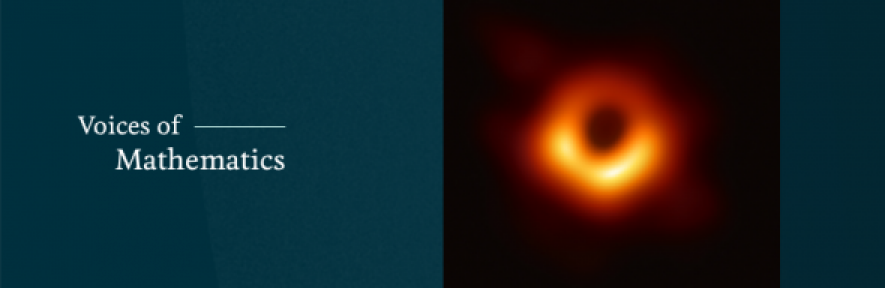
[34:39] Seppe Staelens: Well, yeah, so the Event Horizon Telescope is another famous science result that I definitely remember being in the paper, in the newspaper. So it's the famous image of a black hole. So two of those images have been released so far, in 2019 and in 2022, I think. One of them being the supermassive black hole in the centre of our galaxy. And so the image is very cool. You see some kind of dark region in the middle, then you see a bright orange doughnut, a very fuzzy, smudgy doughnut, and then dark again. And so this picture is the picture of the black hole in the centre of the galaxy. But it's a bit confusing because of course the picture, you're not seeing the black hole on the picture because the black hole is black. And okay, there is a black spot in the middle that you then associate with the black hole, but what you're seeing in the picture is the orange doughnut. And the orange doughnut is the light traveling around and around the black hole in the way Uli described, because if one thing is clear from the picture is that there is something very compact, so very heavy in a small volume in the centre of our galaxy, and there is light orbiting around it forming this doughnut, but we don't see the black hole, we see the light around it.
And so suppose, we're absolutely not saying that this is the case, but suppose we put one of our boson stars in the centre of the galaxy, and we make them so compact that they have a light ring, in principle, they could make a similar image because they would be black, as we mentioned before, because they don't couple the light. They have a light ring, so light can orbit and orbit around it. So we would still sort of imagine some kind of orange doughnut around a black spot. There is other subtleties, and it's very likely that the thing in the centre of a galaxy is not a boson star, but conceptually, in principle, it could be that it's not a black hole, just some other exotic compact object, a black hole mimicker, that just has a light ring that could generate such an image. And so we actually put a figure like that in the paper, just highlighting how similar our boson stars look to a black hole. Not a very realistic simulation, but a quick simulation showing the bending of this light.
And so the whole point is that if we want something that looks very much like a black hole, both in gravitational waves, as we've been talking about for a long time, but also like these pictures. We likely want something that has a light ring, because this will mean that it can mimic those Event Horizon Telescope pictures very well. But you can also show and argue that it will also mean that the gravitational wave signals will look very similar, because some details in these gravitational waves are also related to properties of the light ring and the fact that it's so compact.
And so our paper specifically is about that kind of boson stars that have a light ring. And the instability that we were talking about, or the conjectured instability was also associated with this light ring. But so the paper shows that at least numerically, these boson stars are not as unstable as people thought, even though they have such a light ring. And so this makes them very interesting black hole mimicker candidates, because they would mimic black holes in all these different ways.
[Music plays]
[38:02] Rachel Thomas: Woohoo! So boson stars are still in the game as black hole mimickers.
Marianne Freiberger: Yes, they are. And another recent paper from the Perimeter group also confirms that.
Rachel Thomas: Fantastic. So what's next in their research?
Marianne Freiberger: Well, that's what I asked Uli.
[38:17] Ulrich Sperhake: We're probably not going to have a case where there will be a paper that we've observed a boson star. The much more likely scenario. there are two likely other scenarios. One is that we keep observing events that are totally explained by black holes and neutron stars, end of story. But I can definitely imagine it as a feasible possibility that there will sometime be an observation where we conclude there is a fair chance it's not a black hole or a neutron star. We don't really know what it is. And then you will have the scientists who have their prepared papers already in the drawer about all kinds of possible explanations.
Marianne Freiberger: And then you get Nobel prizes, right?
Seppe Staelens: And then we're … very likely not. Very likely not. [Laughter]
[39:06] Ulrich Sperhake: But then people will start speculating, what could it be? Boson stars is just one of the possible explanations, but it will definitely not be the only one. People may think, oh, I think it could be a cosmic string. Because our observations are not perfect, especially in astrophysics, this is very often how science progresses. And you see something that doesn't fit. And then you start making suggestions, what could it be? And someone wins the lottery. And this is why we think better modelling the boson stars is very important. It's not necessarily because what we will see will be boson stars, but they might help us observe something, we say, look, this is something else. Something doesn't fit here. Could be a boson star, could be something else, but the boson star is a better match than a black hole. And once we have that, this doesn't mean it's a boson star. It could be all kinds of other things that we haven't modelled yet. But it might help us seeing something, hey, something's wrong here.
Seppe Staelens: And that's going back to the construction of the database. Boson stars are just the easiest way of constructing an alternative to black holes that at some point could be preferred over the black holes. And that by itself would be enough, let's say that could be enough to win a Nobel price. It won't be us, very likely not. But the point is that in itself is a discovery. And then the second question will be, what is it actually? Is it actually a boson star? Also likely not, or at least realistically not. But then that's the second question. But it's… the first important question is not to find what it is, but is it not a black hole?
[40:53] Rachel Thomas: So that's how science goes. We invent something that probably doesn't exist just to show that what we see is not what we think it is. Clear?!
[Laughter]
Marianne Freiberger: Yes, very. But it's all because we suspect there's much more out there than we know. As Seppe said, we have never been finished with physics and it's very unlikely that we are now. New things are going to come along.
Rachel Thomas: And we really look forward to hearing about the next exciting advances from Uli and Seppe and all their colleagues. That's it for today's podcast. If you've enjoyed it, please recommend it to a friend or rate and review it wherever you're listening. Thanks for listening and bye for now.