

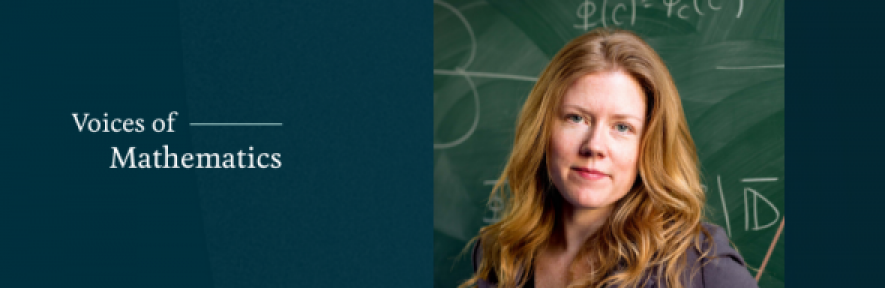
You can listen and subscribe to our Voices of Mathematics podcast through Apple Podcasts, YouTube, Spotify and through most other podcast providers via Podbean - this episode is listed without the transcript on the Maths Faculty website.
The transcript was created using AI to generate the text from the podcast recording, and was then sense-checked and edited for readability and accuracy.
[Musical interlude]
[00:14] Holly Krieger: Mathematics is a very good career to be a human person in, if that makes sense. I think there's a stereotype that you're shutting yourself up in an office and working frantically 20 hours a day and so on, and it just does not have to be true. It's a career that can involve a lot of flexibility, right? It can involve a lot of travel, and all of that – you have to be willing to move, okay? But a lot of that is stuff that I think people find really valuable right now in terms of trying to balance work and life.
[00:53] Marianne Freiberger: Hello and welcome to Voices of Mathematics, the podcast from the Mathematics Faculty at the University of Cambridge. I'm Marianne Freiberger.
Rachel Thomas: And I'm Rachel Thomas, and we're from the Outreach and Communications team here. The person you just heard is Holly Krieger, who is Professor of Mathematics at the Department of Pure Mathematics and Mathematical Statistics, also known as DPMMS. And Holly was explaining why it's great to be a mathematician. So Holly's also a Corfield Fellow at the Murray Edwards College here in Cambridge, and she's well known for her appearance on the Numberphile YouTube channel, those amazing videos about maths produced by Brady Haran. Holly recently gave a colloquium here at DPMMS and these are talks that happen once a term that are aimed at all the pure mathematicians here. Now there's a lot of pure mathematicians here and they work in lots of different areas.
Marianne Freiberger: Yeah, and that makes these colloquia quite special because it's a bit of an honour to be asked to give one because people think you've got something to say that interests everyone. And you need to think quite hard to make sure that what you're saying is actually accessible to everyone in your audience.
Rachel Thomas: So Holly is the latest colloquium speaker and otherwise a very impressive member of DPMMS. She's won some very prestigious prizes. So we decided to catch up with her. Marianne, you got a chance to talk to her.
Marianne Freiberger: Yeah and later on in this podcast, she will tell us more about her appearances on Numberphile and what it's like working at the Faculty and also what advice she has for young mathematicians. But first, we find out about her work, which is in the overlap of number theory and complex dynamics. I asked Holly what drew her to these areas and she had quite a surprising answer.
[02:36] Holly Krieger: So I don't know if this is sort of a... an expected answer, but actually what I liked most about these areas, which I sort of started specializing in graduate school, which is normal, was the people that work in them. So I had in fact started in a different area of mathematics, which will go unnamed. Did not, after my first couple of conferences that I attended, see myself working with that group of people well for the next five or six decades. And so I branched out a little bit and I found essentially a friendlier group of mathematicians that really were more inspiring to me as colleagues. And so that's how I ended up in these fields. I mean, that was a while ago. Of course, since then I've gone in directions that I find mathematically interesting as well. But even now still, like the problems I work on are very influenced by the people I collaborate with. And that's really a choice that comes down to like working personality and how we're able to communicate together.
Marianne Freiberger: And it's interesting because somebody else recently said to me when I said, when I asked them what their advice would be for a young mathematician and they said, be aware that it's not just the area of math, but the people you work with, you'll be stuck with them for life.
Holly Krieger: Yeah, that's right, that's right.
[03:52] Marianne Freiberger: So what is it about the people that, you know, about that community that makes it?
Holly Krieger: It's a good question. I mean, so it really depends on a few different things. So one thing is that arithmetic dynamics, which is sort of the intersection of these two fields, is a pretty young field. Significant work in the field was sort of founded by mathematician Joe Silverman. And this was only about, well, 30-ish years ago. And so a lot of the people in the field are younger, so that's helpful. I think also this is something where a small number of people can make a difference that ... with three or four senior people in the field who have attitudes that are very much positive and interested in interacting with younger people in the field. I think it comes down to a small handful of people who are really the leaders in the field, being people who are very pleasant to talk mathematics to and very, very nice to work with.
[Musical interlude]
[05:06] Rachel Thomas: That's really interesting. I think one of the things people don't realise about working in mathematics is that it's very much a job about working with other people and the importance of working... of who you work with and how you work with them. But of course, what also attracts mathematicians to their job is the mathematics. You said Holly works in the intersection of number theory and complex dynamics.
Marianne Freiberger: Yes, she does, and she'll explain more about this in a minute. But first, just for a little bit of preparation, number theory is what the name suggests, is the study of numbers. And it's famous for problems that are quite easy to state, but then really, really difficult to actually prove. There's a very famous example, which Holly will mention, and it's called Fermat's Last Theorem. Rachel, you want to remind us of what that says?
Rachel Thomas: Of course. So, one way to get a picture of it is if you think of a right-angled triangle, then we know that the square of one side x2 + y2 equals the square of the hypotenuse. And there's lots of examples of right-angled triangles where the length of those sides are all integers. For example, you can have 32 + 42 = 52. Now imagine you chat... you slightly.... like mathematicians do, you generalize things and rather than thinking of what integers satisfy x2 + y2 = z2, you say what happens if..., what integers satisfy x3 + y3 = z3 or x4 + y4 = z4, or raising it to any positive integer power. Can you still find the integer numbers, whole numbers x, y and z that satisfy that? And now what's interesting is the answer is no. And Pierre de Fermat wrote this, mathematician Pierre de Fermat wrote this, he wrote that in a margin of a textbook and said he had a marvellous proof, but actually it took around 350 years to prove that. And it was announced here in Cambridge by Andrew Wells in 1993.
Marianne Freiberger: Right, that's right. So, Fermat's Last Theorem is a theorem in number theory, because it involves the question whether the numbers satisfy an equation. And you've just explained it really, really quickly, but the proof was hundreds of years in the making and that's very typical of number theory. So that's number theory. Can you tell us a little bit about complex dynamics too?
Rachel Thomas: Okay, I definitely will, but I will be very vague so that we can go back to Holly. So complex dynamics involves complex numbers, which are those numbers you might have heard of that have a real part and an imaginary part. So you have x + iy, and that means you can think of a complex number as points in a two-dimensional plane. A complex function is a mathematical expression which takes each point from the plane to some other point in the plane. And if you apply that function again and again and again, you can track the trajectory that any given point takes as it gets taken to another point and then another point by the function. That's called a dynamical system because things move. They're dynamic. So complex dynamics is what gives rise to some very famous and very beautiful fractals such as the Mandelbrot set and also the Julia set.
Marianne Freiberger: Yeah, great, thanks. And we'll put some links in the show notes with more information. Now back to Holly, I asked her what drew her mathematically to the areas of number theory and complex dynamics.
[08:32] Holly Krieger: Yeah, I mean, I've always been interested in number theory for the very basic and I think very common reason that the problems are so easily stated, they seem so fundamental, right? Like I assume that every person who goes into physics at first wants to understand the universe, right? Like they want to understand the building blocks, at least, you know, when they're 16 or something like that, and they decide they're interested in it. And similarly, if you're interested in the building blocks of mathematics, to me, that's number theory, right? Like what can we say about the prime numbers, these sort of multiplicative building blocks of arithmetic? So that's very natural to me. And arithmetic geometry as well, just saying, can we solve polynomial equations, right? Like Fermat's Last Theorem, I think catches people's interest because it seems so fundamental. And so number theory, I think, is something that is a very easy sell in terms of being interested in, because the questions are very fundamental, but they've been studied for so long that there's a lot of mathematical depth there and a lot of interesting techniques and a lot to learn.
Complex dynamics, I think, became interesting to me. I mean, again, in part because I started interacting with people who were interested in complex dynamics that I found very fruitful. But I think also there is an appeal to the field, which is it has a flavour of experimentation. Even though it's a field of pure mathematics, you can sort of draw these wonderful pictures and see maybe what you expect to happen or make predictions about what you think is happening mathematically. And it's motivated by that kind of experimentation in a way that parts of arithmetic geometry, I think, are not. And so I liked the interaction there.
[10:15] Marianne Freiberger: And maybe if we can give a brief glimpse, so complex dynamics, it's about dynamical systems defined by equations.
Holly Krieger: Yeah, that's right. I mean, so what is a dynamical system at its heart? It's really just a function, right? Like a rule from moving from time zero to time one, and then time one to time two, and so on. So we use dynamical systems, we use the maths of dynamical systems to describe, say, you know, orbital mechanics or, you know, where all the planets are right now, that kind of thing that we're all familiar with. In the more abstract setting, this can be somehow actually much, much simpler maths in a sense, right? Even just to say like, I'm taking a complex number and then I'm squaring it, and then I'm squaring it again, and then I'm squaring it again, and what can I understand about what this maths does to the complex numbers? It's a very simple question, and indeed that's kind of a simple example, but it is an interesting one.
Marianne Freiberger: And I mean, these kind of things that people might be familiar with, like the Mandelbrot set, for example, come from literally quadratic functions.
Holly Krieger: Yeah, that's right. The most basic possible ones that, I mean, okay, there are linear functions, they don't have very interesting dynamics. And yeah, that's right. The next simplest case somehow is really fundamental, from which the Mandelbrot set arises.
Marianne Freiberger: So the Mandelbrot set is... people might have heard of it as a fractal. There's also things called Julia sets, which are fractals, and they're all very beautiful. Does that add to the appeal of the area, like the pictorial side?
[11:43] Holly Krieger: I think not from an aesthetic viewpoint for me. I mean, it's nice to see that the pictures are beautiful, but more from what I was saying about experimentation, that I can really, if I see some phenomenon in front of me in the picture, then try to describe it mathematically, and then even better, prove it mathematically, then there's something satisfying about, it's almost... it feels like an observational science a little bit in a way that other areas of pure mathematics may not always.
[Musical interlude]
[12:23] Marianne Freiberger: And so this is dynamical systems, you've talked about number theory. So how do those two link up?
Holly Krieger: Yeah, it's a good question. There's a lot of ways. So let me just describe a couple of the ones that people might be familiar with. I mean, one thing to know, first of all, is that some of the things we're most interested in number theory are secretly dynamical, right? Some more secretly than others. So for example, the Fibonacci sequence, right, which has attracted a lot of interest and still has lots of open questions. Like, here's something we don't know the answer to. Are there infinitely many prime Fibonacci numbers?
Marianne Freiberger: We don't know that? Interesting!
Holly Krieger: We don't know the answer to that, right? So the Fibonacci sequence is, of course, dynamically generated, right?
Marianne Freiberger: Yeah.
Holly Krieger: You can think of it as: I've got a sequence where I take the last two numbers and add them together to produce the next.
Marianne Freiberger: Which is a dynamical...
Holly Krieger: Which is a dynamical process. And in fact, you can even put it in terms of like a single, you don't have to think about taking the last two if instead you construct a map on like a vector with two elements. You can really just put it into this context of complex dynamics totally cleanly.
Marianne Freiberger: Interesting.
[13:26] Holly Krieger: So there's that connection of things that we've already been familiar with from number theory having a dynamical interpretation. And then, of course, once you have the dynamical interpretation, you can either say, generalise what you know about Fibonacci to other similar dynamical systems, say, or you can say, hey, I've got all these dynamical tools. Can they tell me anything that the number theoretic tools couldn't? So that ladder has been successful also. For example, elliptic curves, which are a very well-studied subject in number theory. They're at the heart of the proof of Fermat's Last Theorem, for example. They have relationships to cryptography and so on. They come naturally with dynamical systems because one of the key sort of algebraic features of an elliptic curve is you can add points together on elliptic curves. This is why they're powerful, right? They're geometric things which also have algebra and also arithmetic. So the algebra itself of adding a point to another point, that's a dynamical system if you add a point to itself, right? So I can take some point on the elliptic curve, I add it to itself, I get another point on the elliptic curve, that's exactly, and then I can repeat the process. That's a dynamical system.
Marianne Freiberger: Oh, interesting, yes.
Holly Krieger: And so a lot of things that you can say or predict about elliptic curves can be directly translated into dynamics. And so that's another point of connection that's been really fruitful.
[14:52] Marianne Freiberger: Okay, that's very interesting. And in your work, generally, is there, we often ask people that, do you have a favourite mathematical moment? Like, is there something that always springs to your mind when you think about doing maths? Like a moment where you realize something where, yeah, where you had a eureka moment or maybe something else.
Holly Krieger: Yeah, no, it does happen. It does happen. Maybe once every seven years. I mean, I say, I do remember them. I even remember my first one, which I think I've spoken about in public before, which was, I won't go through what the theorem was. Anyways, I was studying for something late in my undergraduate degree and I was sort of up late trying to understand the proof of this theorem, which is a first theorem in an analysis called the Bolzano-Weierstrass theorem. Okay, whatever that is, it's fine. And I had read the proof a few times and of course met it in lectures and just, it didn't click, right?
And at some point, I don't know, late in the night, it did. And I can't explain to you why. I read it for the 100th time, and suddenly I understood it when I hadn't before. And the thing that is so shocking, and this has also happened in research now a couple of times and so on, but the thing that is shocking is that it's not that you go from not quite understanding it to kind of understanding it. It's like you go from pitch black to the surface of the sun, right? Like not only do you understand it, but you can't understand how you didn't understand it before, if that makes sense, right? [Marianne: Yes, yes.] Like it's so clear all of a sudden that it doesn't make any sense. And this does happen. I mean, this phenomenon does happen in research, but somehow less frequently, because you have to take the time to convince yourself a little bit when you're really working on something new and not an argument that someone else is presenting to you. You have the moment, but it's not quite as certain, I suppose, sometimes. Sometimes it is, but not as often.
Marianne Freiberger: And it's not... because then when you're doing your own research, you're not, yeah, you're not just consuming something. You're not just passively trying to understand something.
Holly Krieger: That's right! Yeah, and so... and you want to... I mean... at least, I make mistakes all the time, and so you feel like this might be, this might be what I need, this might be it, I might understand it now. But then you want to check.
[Musical interlude]
[17:22] Marianne Freiberger: So apart from doing the maths and the research, you're also quite active in communicating it to wider audiences. So, for example, through Numberphile. What do you enjoy about that and why do you think is it important?
Holly Krieger: Well, it's important because my friends are impressed when I get recognized in public, of course! [Laughter] No, I'm just kidding. You know, there is... I love talking about maths with other mathematicians. But when you've specialized in something for a long time, you lose a little bit of openness, right? I think people that are interested in understanding mathematics but are not mathematical specialists are more open to learning about the connections between different fields of mathematics. They're more open to new techniques or ideas that they haven't met before or accepting them or trying to poke around at why they might be true or not be true. And so they sort of let it fill their brain in a way that mathematicians don't, right?
I mean, if somebody... if I go to a maths talk, that's aimed towards me, I sort of file it away in my mental filing cabinet of mathematics, like, okay, it's related to this and that and the other thing, and I understand this part and not that part. Instead of just sitting there and sort of appreciating in itself what has been done. And I think so communicating to audiences that are still learning, but choosing to immerse themselves in mathematics, is somehow satisfying. It's a more receptive audience in some ways.
I think also the truth is just that, it just is rewarding on the most basic level to have someone tell you, I didn't know this was a thing, I now find it interesting, I want to understand more about it and this was worth my brain time, right? And so it just feels good to be able to communicate with other people on that level, because I think that our chances to communicate... well, okay, I don't want to get too philosophical. The point of life is to communicate with other humans, right? And our chances to do that are often very limited, for example, to the people that we live in the same town as or, you know, work with or something like that. And something that has a big reach, like Numberphile of interested audience, it's just so valuable to be able to establish that little thread of communication with so many people.
Marianne Freiberger: And especially if it's about a subject that – it's so lovely when you can actually interest somebody in something that they're frightened of.
Holly Krieger: Yeah, that's right. That's right. Well, and also just to, I think I didn't recognise when I first started doing Numberphile that anyone would want to watch it.
Marianne Freiberger: [Laughter] Yes.
Holly Krieger: Right, because, I mean, truthfully, not to... Not to make light, but it often happens to me in my personal life that I tell someone what I do, and it's the end of the conversation, right? Or maybe they say, like, I hate maths, or I don't like maths, or I never understood maths, or whatever. And I didn't recognise that there was such an appetite for people to talk to, people who are expert mathematicians, but not expert mathematicians in the sense that, oh, I'm going to be totally incomprehensible, but expert mathematicians who actually want to excite other people about what they're doing. And so that was really, it was a surprise to me, but also I'm just really, really grateful for it, right? I mean, it was a happy surprise to me.
[21:00] Marianne Freiberger: Yeah. So what would your advice be for younger people who are thinking about going into research maths?
Holly Krieger: I would certainly reiterate the advice about thinking about who you work with and not getting so focused on a field of mathematics. I mean, for no other reason, if you're really going to do this for 50 years, you're going to branch out eventually, right? You're not going to stay in the same thing. And it's just so critical who you work with.
I think maybe I'll give two pieces of advice, which I'm stealing because they're pieces of advice that I got. The first one is that mathematics is a very good career to be a human person in, if that makes sense. I think there's a stereotype that you're shutting yourself up in an office and working frantically 20 hours a day and so on. And it just does not have to be true. It's a career that can involve a lot of flexibility, right? It can involve a lot of travel. And all of that... you have to be willing to move, okay? But a lot of that is stuff that I think people find really valuable right now in terms of trying to balance work and life.
The other very good piece of advice I received is that when you are stuck or when you are struggling in your personal life or when your advisor is away for a month and you don't know what to do, the answer is always the same answer, which is keep working. [Laughter]. I mean, it sounds so basic, but I think it's really easy. A PhD is so free form, right? Maybe you're lucky you go to some courses for a year or two or something like that if you're in a US style PhD. But a lot of the time you're just sitting there, your job is to sit there and think. And occasionally listen to other people talk about mathematics, but usually it's just to sit there and think. And it's just so easy, and it happens to everyone eventually, that you just get sort of paralysed with, will I ever prove anything? And then once you prove something, you're like, well, will I ever prove enough to write a paper? Oh, well, I've written a paper. Will I ever prove enough to write a thesis? And so, every stage, you don't know, and you freeze for a little while. Most people. [Laughter]. Including myself, certainly. And so the only thing you can do at that point is to take those voices in your head, you accept that they're in your head, and you just keep working anyways. So that's my advice. Keep working.
[23:22] Marianne Freiberger: Keep working. [Laughter]. That's good advice, actually. And it's not one that has come up a lot. That's a new one, actually.
Holly Krieger: Well, it can sound quite cold when you're giving it in person, right? If I have... If I have a student who comes to me struggling and I say, just keep working, [laughter] they might not quite feel like I've heard about their struggles, right? And I'm not sure I appreciated it when I received that advice, at least not in the moment. But it was actually incredibly useful advice. I think because one of the toughest things about it is this, it's just intellectually difficult to get far in mathematics, right? You have to sit and think deeply for a long time. And so, as I said, everyone's going to get stuck at some point. And one of the things that's really easy to happen and that you really want to avoid is getting somehow circularly stuck, which is not only are you stuck, but then you're beating yourself up for getting stuck, right? And you're questioning yourself and you're going around and around and around this circle of negative thoughts about how hard this all is, right? And you can't stop the first one. You can't stop the first thought that this is hard because it is hard. But what you can do is you can take that and say, okay, this is hard and I'm going to carry on anyways.
Marianne Freiberger: And there's some faith in that advice, right? That faith in that it will actually... you will become unstuck and something will...
Holly Krieger: That's true, that's true. I suppose the more pessimistic advice that I would also give is that not ending up with a maths PhD, not the end of the world.
Marianne Freiberger: [Laughter] That's true. People do live without maths PhDs.
Holly Krieger: Not the end of the world. I know a lot of people who have stopped being a mathematician at various phases of their career and who have led very successful and contented lives.
[25:14] Marianne Freiberger: Yes, and there's a lot you can do with your skills as well. So you said you've been here in Cambridge at the Department for Pure Mathematics and Mathematical Statistics for 10 years, nearly 10 years. So, what's it like working here?
Holly Krieger: Oh, it's fantastic. I mean, it's basically the best job a mathematician can have. The quality, like the level of seriousness and mathematical depth of the colleagues that I have and the students that I have is, I mean, I know it's an overused word, but the right word is inspiring, honestly, right? Like if you are the kind of person who sort of levels up to where the people around you are, this is a phenomenal place to be. I think that, you know, there's, when people hear Cambridge, Cambridge maths in particular, they think about ego and intensity maybe is the right thing to say. And I think that those are both valid things to think about Cambridge maths. And so I personally, I sort of thrive in that department. I want my ego to match everybody else's, and I want it to be justified, right? I mean, you want to work as well as everybody else does. And so I find it incredibly inspiring, and especially, I mean, the shocking thing is the students.
You know, there is just... I'm now used to it after 10 years or so, but comparing my 20-year-old self to these 20-year-old students is really... I just am so impressed every time with how mathematically mature they are, honestly, and how focused they are on what they're doing. So that's really a pleasure, is to teach someone who really cares and wants to learn what you have to teach them is... you can't beat that, really.
[27:02] Rachel Thomas: That was Holly Krieger talking to Marianne here at the Centre for Mathematical Sciences in the University of Cambridge. That's it for this podcast. If you've enjoyed listening, please consider recommending us to a friend or rate and review it wherever you've been listening. Thanks for listening and bye for now.