

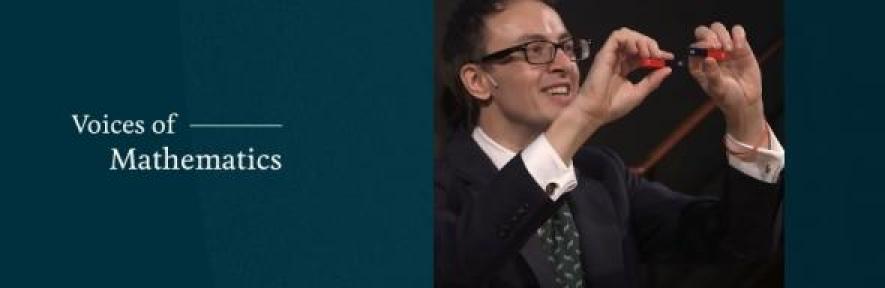
You can listen and subscribe to our Voices of Mathematics podcast through Apple Podcasts, YouTube, Spotify and through most other podcast providers via Podbean - this episode is listed without the transcript on the Maths Faculty website.
The transcript was created using AI to generate the text from the podcast recording, and was then sense-checked and edited for readability and accuracy.
[Musical interlude]
[00:12] David Tong: That's exactly the fundamental description of our universe: it is a collection of fields, depends how you count, but a dozen or so different fields, all interacting with each other. So, the one field oscillates up and down, it sets in motion the other fields, they in turn set in motion the first ones, so there's this beautiful dance.
[Musical interlude]
[00:44] Rachel Thomas: That was Cambridge physicist David Tong giving us a complete description of our universe. And it's a very appropriate way to start this, the first ever edition of Voices of Mathematics, the podcast from the Mathematics Faculty at the University of Cambridge. I'm Rachel Thomas.
Marianne Freiberger: And I'm Marianne Freiberger. And we are from the Maths Communication and Outreach team here and from plus.maths.org, also known as Plus.
[Music plays]
Marianne Freiberger: In Voices of Mathematics, we will be taking you straight into the Maths Faculty, the home of the two mathematics departments here at Cambridge. That's the Department of Applied Mathematics and Theoretical Physics, and the Department of Pure Mathematics and Mathematical Statistics. And these are, of course, among the leading maths departments in the world. In Voices of Mathematics, we will be talking to researchers and students. We'll hear about some of the cutting-edge mathematical research that's going on here, and we'll find out what it's like to work or study here at Cambridge.
Rachel Thomas: In today's podcast, we'll be talking to David Tong, who we've just heard from, and who is Professor of Theoretical Physics. We talk to David about a very important milestone in the history of physics, the 100th birthday of quantum mechanics, which we celebrate this year in 2025. So David is going to tell us why such a groundbreaking new theory was needed when it was invented 100 years ago. And he's also going to tell us which of the many strange aspects of quantum mechanics is, in his opinion, the most significant. And he'll also explain how quantum mechanics links through to the dance of fields he mentioned in his opening quote, which constitutes his own area of research, an area called quantum field theory.
Marianne Freiberger: Yeah, I was lucky to talk to David about all these things in his office at Trinity College recently. But before delving into all things quantum, I asked him about a very ambitious and personal project that he's currently working on.
[Music plays]
[02:14] Marianne Freiberger: So David, you have a project of writing 10 textbooks to basically cover all of theoretical physics, right?
David Tong: I do, yeah. Stupid, isn’t it?
Marianne Freiberger: Why? What's your motivation for that? And why do you think it is necessary to do that now?
David Tong: I don't think it's necessary to do it now. It's just that for me, this is the first time it's been possible. So, I've been teaching here in Cambridge for 21 years. I did something a little strange, which is that I taught a new course every single year on average.
Marianne Freiberger: Did you choose that? Was that a choice?
David Tong: Yeah, because I get bored really quickly, really quickly. So I'll teach, you know, you have to teach two courses every year. And if I teach a course for more than two years, I'm basically, I know what I'm going to say, because I said it last year. So it just somehow, it's not as exciting to teach a course over and over again. It's much more work, of course, to keep teaching something new. But I like learning. I became a physicist because I like learning physics. And this is an amazing opportunity to stand up in front of incredibly smart kids and try and explain physics to them. It really sort of keeps you sharp and makes you learn it yourself.
And so I've been doing this for 20 years. I think there's... I don't know how many lecture notes I've written. Every time I teach a course, I write lecture notes, put them up on my website for free for people to download. It's maybe 23 or 24... with an average of 200 pages each. So there's a lot of material up there. And after 20 years, I sort of got to the point, I wasn't getting close to finishing, but I could start to see where all the holes were in the programme. And I could sort of see that if I wanted to have some finished, polished product, there was a way forward where I could start filling in some of those gaps. So that's what I've been doing for the last two years.
Marianne Freiberger: So which of them are finished? And which of them are you still planning?
David Tong: The ones that are finished are Classical Mechanics and Electromagnetism and Quantum Mechanics and Fluid Mechanics. And they came out last month, published by Cambridge University Press.
Marianne Freiberger: All at the same time.
David Tong: All on exactly the same day. I don't think anyone has ever been foolish enough to publish 4 books on the same day before. They are completely beautiful. I am very, very happy with them. And so the plan is to keep going. So next is statistical mechanics. That's the big topic that would have been nice to have included in the first batch, but I just didn't have the energy. And then I'll keep going through. So the first book starts with the definition of a particle and then Newton's laws. And so it starts very, very basic. And the plan is to go all the way through to quantum field theory and general relativity and the work of Stephen Hawking. And so really, getting to the end of what we currently know about the laws of physics.
Marianne Freiberger: Who's the audience? How far advanced do people have to be to be able to read these books?
David Tong: Really, first year undergraduate is where it starts and then goes up to PhD researchers. But I think university age onwards is really the audience. I have a hope, this may be optimistic, that there's ... It used to be that when you write popular books, you couldn't include an equation. Famously, Stephen Hawking said that every equation he put in would drop his sales by a factor of two. He could have put in many equations, still have been a rich man, but that used to be the case. I don't think that's true anymore. I think there is an audience out there who wants something more sophisticated, where they're not afraid of seeing an equation and being walked through it. And so my books are more advanced than that. But I think if there was someone who did an undergraduate degree in mathematics, say, or in physics and wanted many years later to start to learn the subject again and get a perspective on it, I think it would work for them as well. So that's the hope.
And the idea of doing all of physics, silly as that sounds, is just partly to have a common voice that goes through it, but also to start to draw connections between ideas that you otherwise wouldn't see. So, here's a lovely example. There are certain waves on the Atlantic Ocean that have rather special properties. And when you solve the equations for those waves, what you get is the Schrödinger equation of quantum mechanics. And then you don't have to solve it because you've solved it already in volume 3. You could just say, look, so there are these very surprising connections that link all the way through physics. Just start to see things making cameo appearances where you wouldn't expect them. And I like that. So, it's been fun to bring that out.
[07:48] Marianne Freiberger: Isn't there a link as well between general relativity and fluid mechanics?
David Tong: There is. Firstly, they're the two preeminent equations of classical physics. So, they look very different. But there's this amazing link. I'm not sure if I'll mention this in volume 9, because it's pretty advanced. But if you look at the horizon of a black hole, and you look at how it moves, then it's described by the equations of fluid mechanics. It's sort of amazing that there are these two great equations of classical mechanics, and one of them is a subset of the other one.
Marianne Freiberger: That's amazing.
David Tong: It's beautiful.
Marianne Freiberger: Yeah.
David Tong: It really is lovely.
[08:27] Marianne Freiberger: So, quantum mechanics. Yes. One of your books is on quantum mechanics, and it celebrates its 100th birthday this year, because 100 years ago, two people mostly formulated it, Schrödinger and Heisenberg. [David Tong: Yes.] So, could you give us a bit of a sense of why that was necessary? Could you give us an example of a phenomenon that people had observed that they could not explain with the classical physics they had?
David Tong: Yeah, there were maybe three or four different things. It's worth saying, I think at any time in the history of science, there's always nagging things that you can't quite explain. And more often than not, they just go away. More often you realize the experiment wasn't right or you hadn't quite applied your theory correctly. But in the early part of the 20th century, there were three or four nagging things and they weren't going away.
I think the big one, and certainly the one that motivated Heisenberg and Schrodinger, was what's called the spectral lines of atoms. So, every atom, and indeed every molecule, has, let's say, a unique fingerprint associated to it. This fingerprint, it is that when you shine light at it, it absorbs some light and emits other light, but the light that it absorbs and emits has very specific, distinctive wavelengths. And so we call these the spectral lines.
And one of the reasons it was so surprising is that they're discrete. Most things in physics are continuous, like fluids. A fluid can have a ripple, but it can have a ripple of arbitrarily large or small size. But these spectral lines were wavelengths of light that were very distinctive. It was only very, very specific wavelengths. So it looks a bit like a barcode. You know, things are either on or off on a barcode. It was the same with these spectral lines. That hadn't really appeared anywhere in physics before. Something so discrete, so definite. That's what the quantum in quantum mechanics means. It means something, some discrete amount of energy. So, I think it was that discreteness that was really the big puzzle, certainly for Heisenberg.
Marianne Freiberger: So that was one of the examples of something that needed to be explained with a new theory. And quantum mechanics is famously counterintuitive and it has things happening that we don't observe, like in normal life. So you already told us one strange thing about it, which is this discreteness of things that you would expect to be continuous. Is that the kind of most salient aspect of it if we want to understand more modern physics, the discreteness of it? Or is there another phenomenon we should be keeping in mind?
[11:10] David Tong: There are so many. The lovely thing about quantum mechanics is well, number one, it's very counterintuitive. It's not... It's very hard to see quantum-like effects in our everyday lives. It's really things that are happening on atomic scales, subatomic scales. And that lack of intuition that we have for it is what makes it so wonderful. Because you have to sort of balance seemingly contradictory views in your head. So the first thing about quantum mechanics is that there's a discreteness.
But what Heisenberg really realized is that to understand discreteness, you have to embrace uncertainty, which seems to be the opposite of discreteness. And you need to embrace probabilities and randomness, not randomness that we know in our world. In some sense, there is no randomness in our world. If you throw a dice, as soon as it leaves your hand, the probability that it comes up at 6 is either one or zero. There's no randomness about it. Any randomness that you think is there is because of our ignorance, because we don't know exactly how the dice is spinning or exactly where it's going to bounce. But everything is predetermined for a rolling dice. It's not true for quantum mechanics. There's inherent randomness there. There's inherent probability. And so somehow the lovely thing about the theory is balancing that uncertainty and that fuzziness. Things are ephemeral in quantum mechanics, but with the very definite observations that you get – the quantum of quantum mechanics.
[12:42] Marianne Freiberger: And we're not going to start to try to explain quantum mechanics now, because we can give links in the show notes for people to look up. But given what you've just said, this kind of balancing, what do you enjoy about teaching it?
David Tong: I like teaching everything. I don't think there's been a single course I've taught that hasn't been exciting, where I've found beautiful things and been excited to explain it. But there are two subjects which I think are special, and it's quantum mechanics and general relativity. Because at least when I was at school, they were the reasons I did a physics degree. They were the things that I read about in Stephen Hawking's book or something, and the reason I wanted to go and learn it properly. So I think when I've taught those two subjects, that's when I've sort of felt that I should try and share that excitement more with the students. They're the two special subjects.
[13:41] Marianne Freiberger: And I talked to you recently, and I think you said something interesting about what it's like to go back to read some of the original quantum mechanics papers. I think it was one of Heisenberg's you were talking about. What is that? Can you tell us what you found interesting there?
David Tong: Yeah, so I, because this is 100 years, I've been going back and reading all of these old papers. The Heisenberg one is the amazing one. He was the first person to really understand what quantum mechanics is. What I think he understood what quantum mechanics is.
So there's this incredible story. He'd been struggling to understand these spectral lines. He was working with Niels Bohr in Copenhagen. He had terrible hay fever. And he had these prescription meds of aspirin and cocaine. Sounds brilliant. And somehow it wasn't doing the job. He still had this hay fever. So he went to this windswept desolate island in the North Sea called Heligoland. Holy Land is the translation. It's a perfect poetic place. Just to escape from the pollen. And it was there he had his breakthrough. His breakthrough was trying to understand these definite spectral lines.
His paper starts with a call to arms. It starts by saying, we shouldn't talk about things we can't observe. It’s like, okay, brilliant. So, what are you going to do about that? What he can observe is these spectral lines. And somehow through this chain of logic that is very, very difficult to follow – even if you know quantum mechanics back to front, it's very hard to understand what Heisenberg is doing – he comes to the conclusion that if you have the position of a particle and the velocity of the particle and you multiply the two together, then the order in which you multiply them together has to be different. The position times velocity is not the same as velocity times position. So he gets very upset about that. And he's trying to figure out what the rule is. And he realizes, well, he writes down a rule that now we know is the rule for multiplying matrices together. But Heisenberg didn't know what a matrix was, which I find incredible. But now, I don't know when I learned what a matrix was. 16 or 17? I learned in school what a matrix was and how you multiply them together when you go along the row and down the column. But back in 1925, physicists just didn't know what a matrix was. He was trying to multiply together infinite dimensional matrices, finding it very – understandably – finding it very confusing. But nonetheless, managed to grasp his way to the theory.
Marianne Freiberger: That's amazing. And it's the fact that these matrices don't commute, as people say, that the order makes a difference, that basically gives us Heisenberg's uncertainty principle.
David Tong: It does, although it takes 2 years to get there. It's not, and now again, you know, it takes 20 minutes in a lecture to go from that fact to very simple proof that you get Heisenberg's uncertainty principle, meaning that if you know the position very well, you don't know the momentum or velocity of the particle. The better you know the position, the less well you know the momentum. But yeah, it's not obvious. It wasn't in 1925 obvious that this was the case. So that first paper by Heisenberg is baffling, is absolutely baffling. Then he worked together with two other physicists, with Max Born and Pascual Jordan, and over the next six months formulated quantum mechanics as we, more or less as we teach it now. And so those two papers that they wrote, the three of them, very easy to understand, really not very different from textbooks, but Heisenberg's first one is really a mystery.
[17:27] Marianne Freiberger: And how does Erwin Schrödinger fit in then? Did he develop his equation that is named after him independently?
David Tong: He would say yes. I don't think it's quite true. He didn't like any of it. He thought these matrices, infinite dimensional matrices, what are you talking about? Everything's so abstract, it doesn't make sense. So, he wanted something simpler. He was inspired by the work of a guy called Louis de Broglie, who understood that particles have wave-like property. And he thought, if particles have wave-like property, there should be a wave equation you can write down to describe them. So, he wrote down his wave equation. This was six months later. This was January 1926. Heisenberg was June 1925. He wrote down his wave equation.
It was much more familiar mathematics. It's, you know, the equation, the Schrödinger equation is not dissimilar from the equation that describes how a fluid moves. It's a differential equation. It's the kind of thing that physicists were very used to solving. You could derive all of the results of quantum mechanics that Heisenberg had gotten much, much more easily with the Schrödinger equation. So somehow it was better in that way. For a few months, there was a big argument. You know, they both thought their theories were right. They both thought the other guy was wrong. At some point, Schrödinger writes in a letter – he's very grumpy at the time, Schrödinger – He writes in a letter. Now these Göttingen physicists, Göttingen physicists in Heisenberg and company, now these Göttingen physicists are using my equation to derive their shitty matrix elements! He was so annoyed that somehow they'd adopted his machinery.
But it turns out, of course, they're just two sides of the same coin. It's the same theory, it's just different ways to write the same theory. We now know of many different ways to write the theory. And it's useful because, as I said, it's very counterintuitive, quantum mechanics. But the fact that you have these different mathematical approaches where you can turn your head and look at the equations in a slightly different way, using a different language, gives us sort of all the intuition that we have for what's going on.
[19:34] Marianne Freiberger: Now, if we fast forward to now, quite a long time to fast forward. So your research area is in quantum field theory.
David Tong: Yeah.
Marianne Freiberger: So that combines ideas from quantum mechanics, but also the ideas of fields. Can you explain how should we imagine a quantum field? And how is the world made-up of quantum fields?
David Tong: I can try. So let me start. Firstly, just remind you what a field is. So we learn in school that there is everywhere in space something called an electric field and something called a magnetic field. So this means that – this is Faraday's great insight – that at every point in the universe there are two vectors. One of those tells you the direction and magnitude of the electric field and the other of the magnetic field. And we also learn in school that when those vectors start to oscillate up and down, when they start to wiggle, that's what we call light. So light is an oscillation of the electric and magnetic.
Marianne Freiberger: Electromagnetic wave.
David Tong: Exactly that. So not just light, X-rays, radio waves, infrared, ultraviolet, gamma waves. The whole electromagnetic spectrum is oscillations of these fields. But we also learn (I think in school) but certainly early in the 20th century, that if you look closely, light is made of particles. This is where quantum mechanics comes in. Light is made of particles that we call photons. And so then there's kind of a question that you have to answer, which is, which of those is fundamental? Is it that the particles are fundamental and that everything's really made of photons and what we call the electric and magnetic fields are built up from lots of particles, photons? Or is it the other way round? Is it that the fields are fundamental and somehow the particles emerge from the fields? And so it's not obvious, a priori, which of those is true. But we now know it's the latter, that it's the fields that are fundamental. And what happens is when the fields wiggle and wave to make electromagnetic radiation, quantum mechanics is at play and it's sort of taking those electromagnetic waves and, if you like, wrapping them up into bundles of energy, discrete energy, and they're the photons. But at heart, it's the field that's fundamental. And then the wonderful thing is that story repeats for all other particles. So everywhere in our universe, there is something called an electron field. And there are ripples of that electron field. Those ripples get turned into bundles of energy. And those bundles of energy are what we call the particles that are electrons. And the same is true for every other particle in the universe. There are quark fields in our universe and Higgs fields and any particle you've ever heard of, there's a field associated to it.
Marianne Freiberger: And those fields then interact and you have these, so you have different fields for different particles, you have interactions between fields and all of that all together somehow makes up our world.
David Tong: That's exactly the fundamental description of our universe, it is a collection of fields – sort of depends how you count, but you know a dozen or so different fields – all interacting with each other. So the one field oscillates up and down, it sets in motion the other fields, they in turn set in motion the first one. So there's this beautiful dance between different kinds of fields. The electron field is oscillating up and down. It gives rise to an electron, which in turn gives rise to an electric field, which tells a ripple of the electron field some distance away, how to move, and so on. Everything is field.
[23:15] Marianne Freiberger: Everything is field. And I think I heard you say in a talk that I watched on YouTube or somewhere that, because we're made-up of matter and we'd normally think of, I have some matter particles inside me and you have some others inside you and you. But if it's all fields as well, then we're all connected.
David Tong: We are.
Marianne Freiberger: We're all connected by fields. So I thought that was quite a lovely, a lovely thought, really.
David Tong: It is nice. I get, I get so many emails from people extrapolating that idea to places it shouldn’t really be taken...
Marianne Freiberger: Yeah, I can imagine. Maybe we leave it as a poetic thought, as a poetic thought rather than pursuing it further.
[Musical interlude]
[24:00] Marianne Freiberger: Can you tell us something about work that you've done recently or currently in the last few years or that you're working on now that you could explain to us regarding quantum field theory?
David Tong: I can try. It's a very technical subject. I can tell you something silly I did, a couple of years ago. As I mentioned at the beginning, I like to find connections between different areas of physics. And one of the things I did, especially while writing this textbook on fluid mechanics, was I learnt a lot of fluid mechanics that I didn't really know before. And I found, so there are certain waves on the ocean, also in lakes, that stick to the shoreline and they move parallel to the shoreline. And they only go in one direction. So they only go clockwise, as if to make sure, – if you're in the northern hemisphere – they go clockwise to make sure that the coast is always to their right. And if you're in the southern hemisphere, they go the opposite way. You know, there's this myth that if you pull the plug out of the sink, the water goes down one way in the northern hemisphere and the opposite way. It's complete nonsense, of course, for the plug in your sink. But it is true for these waves in the ocean. They move clockwise in the northern hemisphere, anti-clockwise in the southern hemisphere.
And then I got quite excited when I learned this, because in quantum mechanics there are also materials now, quantum materials that have the same property, that on the edges of the materials there are electrons that only move in one particular direction and don't move in the other direction. And in the world of quantum mechanics, this is very, very special. This is somehow the materials we're going to build quantum computers out of. They have all sorts of deep mathematics, deep topology associated to them, something called Chern-Simons theory that underlies them, so all sorts of magical things happen in the quantum world. So I was quite surprised that these things exist in the North Atlantic Ocean, for example. So I wanted to understand that, and it turns out that it's exactly the same in the ocean. When you look at these equations of fluid mechanics, they also have this deep topology underlying it, and the equations of fluid mechanics, at least – they're called the shallow water equations that describe these waves – are the same as the equations that describe topological quantum computers.
Marianne Freiberger: Amazing.
[26:30] David Tong: So I have no idea if this is good for anything. No idea at all. But it's the kind of thing I like to play with.
Marianne Freiberger: Yeah, and I mean, connections between fields often lead somewhere.
[26:39] David Tong: That's the hope. So of course, you know, they often go nowhere as well. So you, but that's one of the fun things. Another thing that I've been obsessed with for the last five years is the following question. This one I suspect is a bit more important. There is a mathematical theorem that says you cannot put the laws of physics on a computer.
Marianne Freiberger: I was going to ask you about that.
David Tong: I don't like this theorem. Of course, I can't do anything about it. It's true. It's a mathematical theorem, but it strikes me that it's just too much. It's too strong.
[27:14] Marianne Freiberger: So let's just, because I listened to you talking about this on Sean Carroll's podcast called Mindscapes, which is a very good podcast and we will put links to it in the show notes. But so if I understood it properly, it's like, in order for a) to be able to simulate quantum mechanics on a computer, and also to get rid of some mathematical difficulties, it would make sense to sort of assume that space-time is discrete.
David Tong: That's the obstacle. To simulate things on a computer, you have to make things discrete. And so you have to make space discrete.
Marianne Freiberger: And the theorem says that that's what you cannot do.
[27:53] David Tong: That's right. The laws of physics that we have, it's called the standard model, is the most fundamental laws of physics that we know of at the moment. What's fundamental is time dependent in the history of physics. So it might be overridden, but at the moment, standard model is the most fundamental laws of physics. It has a property called chirality. Chirality is the statement that the laws of physics look different when reflected in a mirror. In other words, if you look at some fundamental interaction between fundamental particles, you can tell if you're looking at it in our world or you're looking at it reflected in a mirror.
Marianne Freiberger: It's like looking at a screw in a mirror and it has a different way of winding around.
David Tong: It's exactly that. The helicity of a screw gets flipped in a mirror. The fundamental particles in our universe have a helicity associated to them. And particles of one helicity interact differently from particles of the other helicity. So, if you're going to mirror, that gets flipped. So, it's a very surprising feature of the laws of physics. It's also the feature of the law of physics that somehow sets everything in the standard model. And it's hard to explain, but these theories that have this property, this chirality, are kind of fragile and precious. There's a mathematical delicacy to them. Where most theories that you try to construct with this property, this parity violation property, they just don't make any sense at all. You have to work hard to make things mathematically consistent. And in some sense, the standard model is the simplest possible theory you can write down that has this parity violation property. So it makes it interesting, but it's also this parity violation property that is the obstacle towards simulating things on a computer. This theorem, there's a mathematical theorem called the Nielsen-Ninomiya theorem from the 1980s that says that you cannot put chiral theories on a lattice, meaning you cannot make space discrete for these theories.
[30:01] Marianne Freiberger: So the theorem says that it's a mathematical theorem, it's proven. So, how can you evade that? Where is the loophole? I mean, where would the loophole be? Is it in the assumptions of the theory of the theorem that it's just got assumptions that our world doesn't satisfy? If the theorem is meant to be false.
[30:20] David Tong: That's exactly it. So there is a long history in theoretical physics of proving no-go theorems, as they're called. But the lovely thing about proving something, it's not something physicists tend to do, but if you do prove something, you've got to state exactly what your assumptions are. And those assumptions can look very, very reasonable, but often the no-go theorems are useful because they provide a route forward, that if you want to go rather than no go, you've got to figure out which assumption you're willing to get rid of. And sometimes you hadn't realized that there were loopholes. There were assumptions that you could live without, let's say. You thought these assumptions were necessary, but this forces you to question them more.
Marianne Freiberger: And you believe that basically this is what's going to happen. We're going to find a way around the theorem, because do you believe it's false?
David Tong: Well, the theorem's true, but...
Marianne Freiberger: Yeah, but there should be a way to apply to our world?
David Tong: There should be a way to put the laws of physics on a computer. If you take this theorem at face value, it's telling us we're not living in the matrix. Because, you know, we can't be simulated on a computer. Now, I don't believe we're living in the matrix, but I don't believe we should be able to have such a simple way to argue against it either. So I would love to find a way to circumvent this.
[Musical interlude]
[31:52] Marianne Freiberger: Is there a particular result or observation from experiment that you would really like to see or that you think will happen in the next 10, 20 years that is important?
David Tong: I don't think we're smart enough to make progress without experiment.
Marianne Freiberger: So we need...
David Tong: I know I'm not. And so I would love to see progress on experiment. That might mean discovering dark matter. Okay, we've discovered dark matter. It's out there. We see it through its gravitational interaction, but finding that it interacts directly with particles in the standard model – might not, it might not interact at a level that we can detect in current experiments – but there's a big push to try and understand that. There's lots of tensions in cosmology at the moment, which, again, you know, you don't know if they're just going to disappear and go away, but just last month, there were two black holes that were seen through gravitational wave collisions, each of which had masses bigger than 100 times the mass of our sun. Now, it's very, very hard to get black holes that are 100 times the mass of the sun unless they were made by black holes previously colliding. It takes billions of years for two black holes to orbit and collide, so it's just not obvious there was time to build these very big black holes. Now, possibly there was. Possibly there are just some nebulae out there where things are very dense and these black hole collisions are sped up and in which case, okay, it's interesting astrophysics, but possibly it's more than that. Possibly there's some fundamental physics that we're missing. Did you know about these little red dots?
Marianne Freiberger: No.
[33:33] David Tong: The James Webb Space Telescope has seen these objects that were formed something like 600 million years after the Big Bang. So they're 13 billion years old, these things they're looking at, they're little red dots, it's seen hundreds of them. We didn't expect to see anything there.
Marianne Freiberger: We don't know what it is.
David Tong: There's various ideas. They could also be black holes, could be supermassive stars, but there was an expectation you wouldn't be able to form things that big and that luminous so early in the history of the universe. So again, is it something fundamental that's going to overturn the laws of physics or is it just messy astrophysics that we didn't fully understand?
Marianne Freiberger: This is amazing. And this is interesting because, so we've touched on, you know, quantum field theory. It can tell you stuff about cosmology, about like the big, wide, outside, far away things. It has mathematics, like a strong mathematical component as we talked about. Can you tell us one thing that people might know that is practical and exists here and now that is only possible because of quantum field theory, like an application?
David Tong: No.
[34:40] Marianne Freiberger: Good. What about like MRI? But they just use quantum mechanics, like MRI scans.
David Tong: Quantum mechanics is everywhere.
Marianne Freiberger: But not quantum field theory?
David Tong: In fact, your atoms don't decay too.
Marianne Freiberger: Yeah, so quantum field theory there isn't something like, I don't know...
David Tong: So everything is quantum field theory at the end of the day. There's also a question of when it's more useful to use that language rather than the language of quantum mechanics. And so there are lots of materials out there. So this isn't fundamental physics. It's just materials that to truly understand them, quantum field theory is the way forward. Superconductors are very obvious. Something called the quantum Hall effect, which is another one of my obsessions. It's an incredible material that has miraculous properties. The only real way to understand it is quantum field theory. So lots of examples like that. You could understand it using quantum mechanics, thinking about particles rather than fields, but it's less useful.
Marianne Freiberger: Fields is useful there.
David Tong: One other thing, when you boil water, so again, the math, it’s almost quantum fields really, the mathematics is almost the same. There's a factor of i difference in the mathematics, but when you boil water, there's this violent bubbling as you go from water to steam. If you crank up the pressure, then there's something called the critical point of water. It's where the difference between water and the gas phase basically disappears. But at that critical point, it's like a fractal. You have water, you should think of water with bubbles of steam, but the bubbles of steam have all possible different sizes.
Marianne Freiberger: So it's a fractal surface? Like, the top of the water?
David Tong: Yes, or fractal volume, I guess, where it's neither water nor steam, but it's sort of this complicated intermixture of both of them. The right way to describe that is also using mathematics of quantum field theory.
[Musical interlude]
[37:00] Marianne Freiberger: So you don't do this work in isolation, you're a member of DAMTP [Department of Applied Mathematics and Theoretical Physics]. And lots of stuff happens there. I mean, we talked about cosmology. There's the Centre for Theoretical Cosmology, Stephen Hawking Centre is there. You know, you're part of a high energy physics research group. There's lots of other people. There's pure mathematicians, of course. What's it like working at DAMTP and DPMMS [Department of Pure Mathematics and Statistics] together?
David Tong: Oh, it's horrible.
Marianne Freiberger: This is going out in the podcast!
David Tong: It's brilliant. It's – yeah – it's really a fantastic place. Firstly, it's friendly, which isn't true of every physics or maths department in the world. But just having that range of expertise, especially as someone who likes to try different things and make connections between fields, and just having the world's experts on my doorstep is amazing. So if I get, you know, I work on general relativity and I get stuck, then I've got Harvey Reall, who's one of the great relativists on the planet, and the office two doors down. You have Stephen Hawking just down the corridor. He's not a bad person to go and ask for help. And fluid mechanics people, as you say, pure mathematicians who I have bugged incessantly over the years to help me solve my problems. High energy physicists, we've got people working on putting quantum field theories on computers. You know, I don't know how to program, even though I'm interested in this problem. I don't actually know how to program anything on a computer, but they do. And the cosmologists, so just having that breadth is what makes it so special.
[Musical interlude]
[38:48] Rachel Thomas: That was David Tong, our neighbour here in the Department of Applied Mathematics and Theoretical Physics, talking to you, Marianne, just recently.
Marianne Freiberger: Yeah, and we will put links to information about some of the topics mentioned in this podcast, including David's amazing and ambitious series of textbooks, into the show notes. I'm Marianne.
Rachel Thomas: And I'm Rachel, and we're from the Maths Communication and Outreach team here at the Faculty of Mathematics at the University of Cambridge. And we're also editors of plus.maths.org, which is also known as Plus, and it's a free online platform about maths research aimed at non-expert audiences. If you'd like to check it out, go to plus.maths.org.
Marianne Freiberger: That was it for the very first edition of Voices of Mathematics. We hope you enjoyed it. And if you did, then please recommend us to a friend or rate and review us on the platform that you get your podcasts from. It will really help other people find it. Thanks for listening and bye-bye.
Rachel Thomas: Bye.