

Would you like to tap into the brains of over 300 world-leading mathematicians? Then the Cambridge Hub for Innovative Mathematics in Research and Applications might be for you.
CHIMiRA, as it is known for short, has just launched at the Mathematics Faculty here at Cambridge, in partnership with the MRC Biostatistics Unit (BSU). It's designed as a gateway to research mathematics for those who need it to solve real-world problems, be it in other academic disciplines, business, industry, government, or the third sector. For mathematicians here at the Faculty CHIMiRA will serve as a direct route to impact.
We are looking for hard problems from industry and academia [to] be attacked by some of the best mathematicians in the world. Ewan Kirk, Entrepreneur in Residence, CMS
"We are looking for hard problems from industry and academia [to] be attacked by some of the best mathematicians in the world," said Ewan Kirk, Entrepreneur in Residence at the Centre for Mathematical Sciences, at CHIMiRA's launch event at Jesus College. "If the people in CHIMiRA can't solve the problem then they [have access to] 300 other incredibly smart people at the Centre for Mathematical Sciences — and if they can't solve the problem either, then it probably can't be solved." Members of the BSU are also at hand to help.
CHIMiRA is run by the Co-Directors Sergio Bacallado of the Department of Pure Mathematics and Mathematical Statistics (DPMMS), Sofia Villar of the MRC Biostatistics Unit, and Michael Roberts of the Department of Applied Mathematics and Theoretical Physics (DAMTP). Kirk brings valuable entrepreneurial and start-up expertise. Executive Directors are David Abrahams and Carola-Bibiane Schönlieb, both of DAMTP.
On the shoulders of giants
The Institute builds on the long history of Cambridge mathematics in delivering extraordinary real-world impact. Isaac Newton, Charles Babbage, and James Maxwell are just three of the giants providing shoulders for contemporary mathematicians to stand on. Modern Cambridge mathematicians work in a broad range of areas, from artificial intelligence and statistics to material science and fluid dynamics, as well as pure mathematical fields that underpin future applications. At the launch event Bacallado mentioned three colleagues as striking examples: Julia Gog, whose advice to government was indispensable during the COVID-19 pandemic; Frank Kelly, whose research helps power smartphones and the internet; and David Spiegelhalter, whose work has helped to revolutionise the way the NHS communicates risks to patients.
"With CHIMiRA we're building on this legacy of impact," said Bacallado. "The new structure is designed to make the next generation of collaborations more agile and scalable, and provide a new home for applied research in the Faculty of Mathematics." The Biostatistics Unit, with its long history of transforming healthcare through data, is a key pillar, ready to support fields such as drug development, clinical trial design, epidemiology, and data science.
Mathematical matchmaking
CHIMiRA will provide a point of call for those who would like to harness the power of mathematics. "[CHIMiRA establishes] a permanent staff of post-doctoral researchers who are exclusively devoted to translating research into real-world impact," said Bacallado. "This team will be able to respond rapidly to urgent challenges and translate them into new mathematics." Three postdoctoral researchers, Yuan Huang, William Lee, and Tram Nguyen have already been hired, but the plan is to scale the number up in the coming years.
Partners can tailor their work with CHIMiRA to their needs by choosing from streamlined collaboration models. Academic researchers can engage in a way that suits their funding structure, with a view to producing new grant applications at the end of a collaboration. Industrial partners can commission short-term projects similar in structure to consultancy work, or longer term partnerships co-designed with CHIMiRA research associates and supported by senior academics.
New mathematical research lies at the heart of CHIMiRA. "We want to transfer the cutting edge knowledge that is being generated at the Faculty to new applications that are truly groundbreaking," said Bacallado. The research focus sets CHIMiRA apart from ordinary consultancy outfits and puts it on par with two similar centres that helped to inspire it: the Institute of Mathematics Innovation at the University of Bath and the Centre for Applications of Mathematical and Computing Sciences at the University of Warwick.
Cambridge mathematicians are all invited to engage with CHIMiRA and they too stand to benefit. Theoreticians often lack the time, resources, and industrial partners to explore potential applications of their work. "CHIMiRA will have this group of people explicitly dedicated to producing impactful research and to foster collaborations," said Bacallado. "We can use that resource to take on more collaborations [with external partners]."
For postdoctoral researchers directly employed by CHIMiRA the attraction is lots of variety and the chance to have one foot in the world of research and the other in industry. "[If you like] doing maths but you want your work to have impact in the real world, this is an ideal opportunity. You can be a bit of a traveller." CHIMiRA postdocs have access to all the opportunities an academic job provides, including opportunities to publish their work.
Saving puppies: A case study
Although the official launch has only just taken place, CHIMiRA has already started operating. Representing industry partners at the launch event was Victoria Johnson, who works in a field you wouldn't usually associate with mathematics — she's a vet. In 2009 Johnson set up the teleradiology company Vet.CT. "If your dog has an injury and you go to the vet, they take an X-ray or do a CT scan," she explained. "This then gets uploaded and a radiologist somewhere else in the world writes an expert report." Vet.CT has over 150 board-certified specialists globally and, as a certified B corporation, prides itself on embedded values surrounding the health and welfare of animals and people.
Data, in the shape of medical images and radiologists' reports, lies at the heart of Vet.CT's activities, so the company was looking for ways to make best use of this gold mine. Thanks to an explorative collaboration with CHIMiRA it is now pursuing a range of projects — from developing tools that can identify an animal's body parts in a scan, to producing automated radiology reports and accurate forecasts of the demand for their services.
CHIMiRA researchers are embedded in the company and integral to product development processes — they are "definitely housetrained" according to Johnson. "[The collaboration] has been fantastic for idea generation and brought new perspectives. The speed at which this works has been fascinating. We start fast, we learn fast. Sometimes we fail fast and carry on in a different direction. This dynamic and iterative process has been [hugely successful]."
The collaboration has been cost effective, said Johnson, and opened opportunities to apply for grants and R&D tax benefits the company wasn't previously aware of. It has also integrated the company further in the "Cambridge ecosystem" and allowed it to preserve the values it feels strongly about.
Open for business
As Bacallado said at the launch event, CHIMiRA is now officially open for business, seeking collaborations to add to those already underway. It will build on the Faculty's experience in running interdisciplinary research initiatives and groundbreaking collaborations. And it won't be constrained by subject boundaries or topic areas.
"We are an open house for ideas," said Bacallado. "So let's start the conversation."
If you have a challenge that requires high-level mathematics, whatever the field, get in touch via the CHIMiRA website.
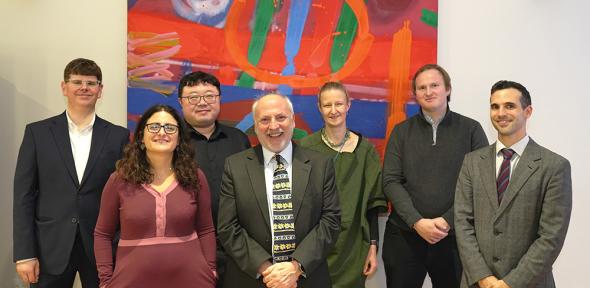
Image at the top from left to right: William Lee, Sofia Villar,Yuan Huang, David Abrahams, Carola-Bibiane Schönlieb, Michael Roberts, Sergio Bacallado.